
7 Smart Ways to Start Investing With $100 or Less Today
Investing can feel intimidating, especially when most advice makes it seem like you need thousands of dollars just to get started. Maybe you’ve thought, “I’ll wait until I have enough money, and then I’ll begin investing.” But here’s the reality, waiting could cost you years of potential growth. The truth is, you don’t need a fortune to step into the world of investing, with as little as $100 or even less, you can start building wealth, experience the magic of compounding, and learn the strategies that set successful investors apart.
Imagine this, while some people are still hesitating to take their first step, you could already be putting your money to work, growing slowly but steadily over time. The earlier you start, the more time your money has to grow, and the more confidence you’ll gain as an investor.
In this guide, we’ll take the mystery out of investing with a small amount, you’ll learn about the types of investments available to beginners, discover practical steps for making your first purchase, and see how small, consistent actions today can lead to meaningful financial growth tomorrow. Whether your goal is to create a nest egg, grow a side income, or simply learn how to invest wisely, this guide will show you how to start, even if all you have is $100.
Why $100 Is Enough to Get Started
Many people delay investing because they think they need thousands of dollars to get started. The reality is, $100 is more than enough to begin your investment journey. Starting small has several key advantages:
Low risk exposure: You can learn how investing works without risking a large sum. Mistakes with $100 are manageable and educational.
Habit building: Starting with a small amount encourages consistency, which is far more important than size when building wealth.
Early compounding: Even modest investments grow over time. For example, $100 invested today at an average 7% annual return could grow to around $387 in 20 years. Adding small, regular contributions turns this modest start into a substantial nest egg.
Step 1: Understand the Basics of Investing
Before you invest a single dollar, it’s important to understand what investing really means. At its core:
Investing is putting your money into assets that have the potential to grow in value over time. Unlike spending, which provides immediate gratification, investing is about earning returns through interest, dividends, or price appreciation.
Common Types of Investments
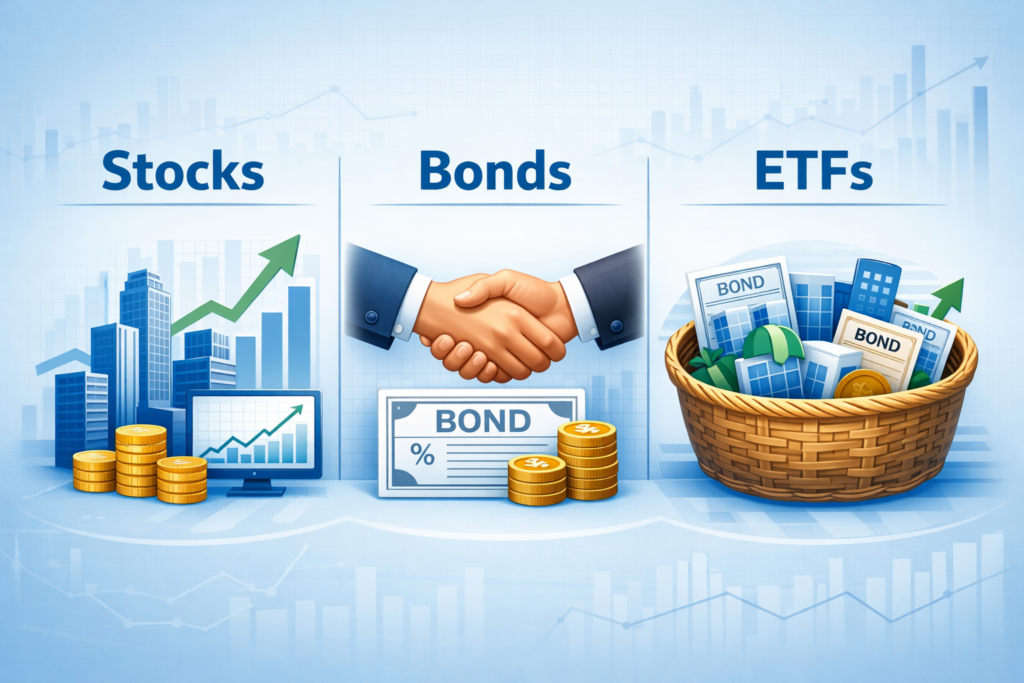
Stocks: Buying a stock means owning a piece of a company. Stocks can offer high returns but carry higher risk.
Bonds: Bonds are loans to governments or companies. They tend to be safer than stocks but usually offer lower returns.
Mutual Funds : A professionally managed fund pooling money from many investors into stocks, bonds, or both.
Exchange-Traded Funds (ETFs): Similar to mutual funds, but traded like stocks and often with lower fees. ETFs are ideal for small investors seeking diversification.
Cryptocurrenc: Digital assets such as Bitcoin or Ethereum. Extremely volatile, so beginners should proceed cautiously.
Savings Accounts or CDs: Low risk, low return options suitable for emergency funds or short-term goals.
For beginners with $100, stocks, ETFs, and micro-investing platforms are usually the most practical options.
Step 2: Set Clear Goals
Knowing why you’re investing is just as important as knowing how. Ask yourself:
Are you investing for retirement, short-term goals, or financial education?
How much risk are you comfortable taking?
How long can you leave your money invested?
Your answers will shape your strategy, if your goal is long-term growth, stocks or ETFs are suitable. If you need the money soon, consider safer options like a high-yield savings account or CDs.
Step 3: Choose the Right Platform
With just $100, selecting a platform that supports small investments and low fees is crucial. Here are some beginner-friendly options:
Brokerage Accounts
Platforms like Robinhood, Fidelity, and Charles Schwab allow you to buy fractional shares, so you can invest in high-priced stocks with just a few dollars.Micro-Investing Apps
Apps like Acorns, Stash, or WiseBanyan let you start with very little money. Some even invest your spare change automatically.Robo-Advisors
Services like Betterment or Wealthfront create a diversified portfolio for you, ideal if you’re not ready to pick individual stocks.Cryptocurrency Exchanges
Platforms such as Coinbase or Binance let you invest small amounts in digital currencies, often starting at $10.
Step 4: Start With Low-Cost Investments
When investing small amounts, fees matter. Minimizing them allows more of your money to grow.
a) Fractional Shares
Fractional shares let you own a portion of expensive stocks. For example, you could invest $10 in Amazon or Tesla even if a full share costs hundreds of dollars. This makes top-performing stocks accessible to everyone.
b) ETFs
ETFs (Exchange-Traded Funds) are collections of stocks or bonds, offering instant diversification. They spread risk while giving you exposure to the broader market. Popular options include:
S&P 500 ETFs (SPY, VOO): Track the largest 500 U.S. companies.
Total Market ETFs (VTI): Provide broader market exposure.
Dividend ETFs (VIG): Focus on companies that pay regular dividends.
High-Interest Savings Accounts
If your goal is short-term, or you want a safe place to park your first $100, a high-yield savings account is ideal. You can earn 3-5% interest with no risk, while you learn more about investing.
Step 5: Diversify Even With Small Amounts
Diversification means spreading your money across different types of investments to reduce risk. Even with $100, you can create a balanced mix:
$40 in a total market ETF
$30 in a tech-focused ETF
$30 in a bond ETF or high-yield savings account
This approach prevents a single investment from dominating your portfolio. If one asset drops in value, the others can help cushion the loss. Diversifying early, even with small amounts, sets a strong foundation for long-term growth.
Step 6: Learn About Dollar-Cost Averaging
Dollar-cost averaging is investing a fixed amount of money at regular intervals, regardless of market conditions. For example, investing $50 every month works like this:
You buy more shares when prices are low.
You buy fewer shares when prices are high.
Over time, this method smooths out market ups and downs, reducing the risk of buying all at once at the wrong price. Even starting with $100, contributing $10-$50 each month can turn small investments into meaningful wealth over the years.
Step 7: Avoid Common Beginner Mistakes
Investing with a small amount doesn’t mean zero risk. Watch out for these pitfalls:
High fees: Commissions, account fees, or high fund expense ratios can eat into returns. With $100, even small fees matter.
Trying to time the market: Attempting to buy low and sell high rarely works consistently. Focus on long-term growth instead.
Over-concentration: Putting all your money in one stock is risky. Spread your investments, even in small amounts.
Ignoring education: Investing isn’t just about money, it’s about knowledge. Regular learning improves your decision-making and confidence.
Step 8: Use Free Resources to Learn
Knowledge is your most powerful investment. Some beginner-friendly resources include:
Books: The Intelligent Investor by Benjamin Graham, A Random Walk Down Wall Street by Burton Malkiel
Podcasts: BiggerPockets Money, The Indicator from Planet Money
Websites: Investopedia, Morningstar, Bloomberg, CNBC
Even dedicating 30 minutes a day to learning can make a big difference in your investing journey.
Step 9: Track Your Investments
Tracking your investments keeps you disciplined and helps identify mistakes early. Tools that make this easier include:
Personal Capital: Tracks net worth and investments
Mint: Monitors spending and investment accounts
Brokerage platforms: Offer portfolio analytics
Set reminders to review your portfolio monthly or quarterly, but avoid obsessing over daily market fluctuations, they are normal and temporary.
Step 10: Be Patient and Think Long-Term
Patience is the cornerstone of investing. A $100 investment won’t make you rich overnight, but consistent contributions compounded over years can create significant wealth.
For example, if you invest $100 initially and add $50 monthly, assuming a 7% annual return:
After 10 years, you could have around $8,700
After 20 years, it could grow to about $23,000
The key is consistency and time. Even small, regular steps pay off when you think long-term.
Step 11: Explore Advanced Options for Small Investors
Once you’re comfortable with the basics, there are ways to grow your money further:
Dividend Reinvestment Plans (DRIPs): Automatically reinvest dividends to buy more shares, compounding growth without extra effort.
Peer-to-Peer Lending: Platforms like LendingClub or Prosper let you lend small amounts and earn interest. Risk is higher, but diversification helps mitigate it.
Crypto Staking: Some cryptocurrencies allow you to stake coins for interest. Only attempt this after thorough research due to high volatility.
Step 12: Start Now, Don’t Wait
The hardest part of investing is starting. Many people wait until they have thousands of dollars, missing years of compounding growth.
Even $100 is enough to learn, gain confidence, and see results. Open a brokerage account, choose a simple ETF or stock, and make your first purchase today.
Real-Life Example: Starting With $100
Meet Alex, a beginner investor in Canada:
Alex opens a Questrade brokerage account, which allows fractional shares.
He invests $100 in a Total Market ETF.
He sets up automatic monthly contributions of $50.
After 5 years, Alex’s initial $100 grows to over $4,000, without trying to time the market, just through consistent investing. The lesson is clear, starting small works, as long as you stay consistent and patient.
Final Thoughts
Investing with $100 or less might feel modest, even insignificant but it’s far from meaningless. In fact, it’s the perfect starting point for your financial journey, the value of this first step isn’t just the money itself, it’s the knowledge you gain, the confidence you build, and the habit of investing that you form, all of which are far more important than chasing quick gains.
Think of your first $100 as planting a seed, at first, it seems tiny and fragile, almost invisible but with time, patience, and consistent nurturing, that seed can grow into something far bigger than you imagined. Each small contribution you make, each investment you track, and each lesson you learn adds nutrients to that seed, helping it flourish.
Here’s how to make that seed grow:
Start now: even with a small amount, don’t wait for the “perfect” sum or the “perfect” moment. Time is one of your greatest allies.
Focus on low-cost, diversified investments: Spread your money across different assets to reduce risk and increase your chances of steady growth.
Use dollar-cost averaging: Regular, consistent investments smooth out market ups and downs and build wealth gradually.
Keep learning and reviewing your portfolio. Knowledge compounds like money, every lesson you learn strengthens your ability to make smart decisions.
Be patient. True growth comes over years, not days. Compounding rewards those who stay consistent.
Remember, the most successful investors didn’t start with millions, they started small, stayed disciplined, and let time do the heavy lifting. Your first $100 investment isn’t just a transaction, it’s a commitment to your financial future. It’s a tangible step toward independence, security, and freedom.
So don’t underestimate it. Open that account, make your first investment, and watch what can happen when patience, consistency, and learning combine. Your journey toward financial freedom begins with this one simple step, and the possibilities from here are endless.
Other Related Blog Post You May Like:
- Stocks vs Bonds vs ETFs: 7 Powerful Differences Every Beginner Must Understand
- How Investing Works for Complete Beginners: 9 Powerful Steps to Start Building Wealth
- Beginner’s Guide to Investing Money Safely: 10 Smart Strategies for New Investors
- Net Worth Explained: 7 Simple Steps to Calculate Yours Today
- 10 Smart Ways to Track Expenses Without Feeling Restricted and Still Enjoy Life
- 21 Personal Finance Basics Every Adult Should Know for Financial Freedom