7 Stock Market Investing Strategies Every Long-Term Investor Must Know
Stock market investing has a reputation for being complicated, intimidating, and risky. Many people think you need insider knowledge, a large fortune, or a crystal ball to succeed. The truth? None of that is necessary. Long-term investing isn’t about predicting every market twist or timing the perfect buy or sell, it’s about patience, strategy, and understanding how businesses grow over time.
Imagine planting a tree, you don’t check every day to see if it’s taller. You water it consistently, give it sunlight, and trust that over years it will grow strong and yield fruit. Investing in the stock market works in much the same way. Small, consistent steps today can lead to substantial wealth decades from now.
This guide is designed to cut through the noise and give you a clear roadmap. From understanding how the stock market functions to building a portfolio that grows steadily through compounding, you’ll learn exactly what long-term investors do differently and how you can apply these strategies to secure your financial future with confidence.
What Is the Stock Market?
At its simplest, the stock market is a platform where investors buy and sell ownership stakes in companies. When you purchase a stock, you are essentially buying a small piece of a business.
Major stock exchanges like the New York Stock Exchange and the NASDAQ make this process possible by connecting buyers and sellers. Companies list their shares publicly to raise money for growth, innovation, or expansion, while investors trade these shares based on their expectations of the company’s future performance.
Over time, successful companies grow, innovate, and increase their value. This growth is reflected in the price of their stocks and it’s where long-term investors stand to benefit the most. By holding shares over many years, you can capture this upward trajectory rather than reacting to short-term market swings.
Why Long-Term Investing Works
Short-term trading is often influenced by news, speculation, and emotions. Prices can fluctuate wildly in a single day or week based on rumors or temporary market fears.
Long-term investing, however, focuses on fundamentals, business performance, innovation, and economic expansion. Historically, broad market indexes like the S&P 500 have returned an average of 7-10% annually after adjusting for inflation. This steady growth doesn’t happen because the market rises every year, it happens because businesses grow over decades, and long-term investors reap the rewards.
Key Drivers of Long-Term Returns
- Earnings Growth: Companies grow their profits over time through expansion, innovation, and operational efficiency.
- Dividends: Many companies share a portion of profits with shareholders, providing a steady income stream.
- Valuation Expansion: As companies succeed, investors are willing to pay more for their shares, increasing stock prices.
- Compounding: Reinvested returns earn additional returns, accelerating portfolio growth over time.
Understanding Compounding in Investing
Compounding is often called the “eighth wonder of the world” in finance and for good reason. It allows your money to grow exponentially rather than linearly.
When you reinvest your gains, you earn returns not just on your original investment, but also on the growth it has already generated. Over decades, this effect becomes extremely powerful.
Example:
- Investing $10,000 at an 8% annual return grows to:
- $21,600 in 10 years
- $46,600 in 20 years
- $100,600 in 30 years
The takeaway? The longer your money remains invested, the more compounding works in your favor. Even small, consistent investments grow substantially over time.
Types of Stocks Long-Term Investors Should Know
Not all stocks are created equal. Understanding different types helps you build a balanced, resilient portfolio.
1. Growth Stocks
Growth stocks belong to companies expected to expand faster than the overall market. Examples include Amazon and Tesla.
Key Features:
- High potential returns
- Usually reinvest profits rather than pay dividends
- Can experience significant short-term volatility
2. Value Stocks
Value stocks are companies trading below their intrinsic value. They may be temporarily undervalued due to market sentiment or industry cycles.
Key Features:
- More stable than high-growth stocks
- Often found in mature, established industries
- Offer potential gains if the market recognizes their true value
3. Dividend Stocks
Dividend-paying companies share a portion of their profits with investors regularly. Companies like Coca-Cola are classic examples.
Key Features:
- Provide passive income
- Typically less volatile
- Ideal for investors seeking both growth and income
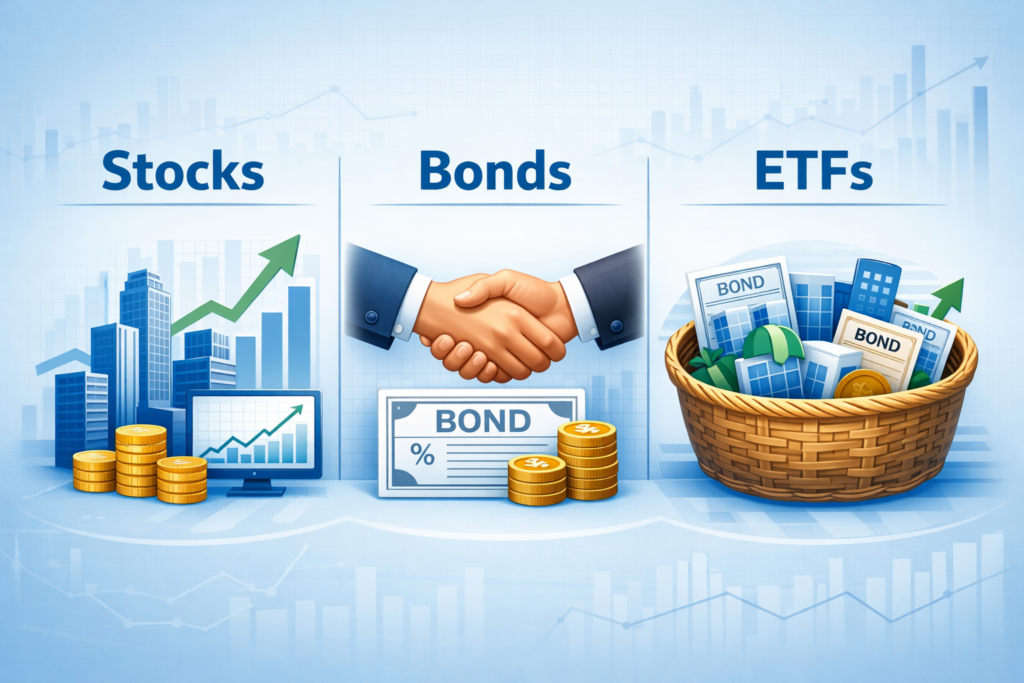
4. Index Funds and ETFs
Index funds and exchange-traded funds (ETFs) track entire markets or sectors, such as the S&P 500.
Key Features:
- Instant diversification across hundreds of companies
- Lower risk compared to holding individual stocks
- Beginner-friendly and cost-efficient
Risk vs. Return: What You Must Understand
All investments carry some risk. The goal isn’t to avoid risk entirely but to manage it intelligently.
Common Types of Risk
- Market Risk: The overall market could decline.
- Company Risk: A single company may perform poorly.
- Inflation Risk: Returns may not keep up with rising prices.
- Behavioral Risk: Emotional decisions, like panic-selling, can harm returns.
Long-term investors reduce risk by diversifying their portfolios and remaining invested for many years.
The Importance of Time in the Market
Trying to time the market or buying at the lowest price and selling at the peak is extremely difficult, even for professional investors. Missing just a few of the market’s best days can drastically reduce your long-term returns.
Instead, focus on:
- Consistency: Invest regularly, regardless of market conditions.
- Patience: Stay invested through downturns.
- Trust in Time: Let the long-term growth of businesses work for you.
Time in the market almost always beats timing the market.
Building a Long-Term Investment Portfolio
A strong portfolio balances growth, stability, and risk. Here’s how to structure it:
Step 1: Define Your Goals
Determine why you’re investing:
- Retirement
- Financial independence
- Wealth accumulation
Your goals will guide your timeline and strategy.
Step 2: Asset Allocation
Decide how much of your portfolio goes into stocks versus other assets:
- 60-80% in stocks for growth
- 20-40% in bonds or safer assets for stability
Younger investors can allocate more to stocks due to their longer time horizon, while older investors may shift toward safer investments.
Step 3: Diversification
Avoid putting all your money into a single stock or sector. Spread investments across:
- Different industries
- Various geographic regions
- Multiple asset classes
This reduces risk and smooths out returns over time.
Step 4: Rebalancing
Over time, some investments may grow faster than others, skewing your allocation. Periodically rebalance your portfolio to stay aligned with your strategy. This keeps your risk and growth potential in check.
The Role of Index Investing
Index investing has become increasingly popular because it simplifies the investing process. Instead of trying to pick individual stocks or predict which companies will outperform, you invest in a fund that tracks the entire market or a specific segment of it. In other words, you become the market rather than trying to beat it.
Even legendary investors like Warren Buffett recommend low-cost index funds for most individual investors, the reasoning is simple, over time, these funds consistently deliver competitive returns with minimal effort and risk compared to trying to pick winning stocks.
Why Index Funds Work
- Low Fees: Minima management costs mean more of your money stays invested.
- Broad Diversification: You gain exposure to hundreds or even thousands of companies at once.
- Consistent Long-Term Returns: Historically, broad market indexes like the S&P 500 have delivered steady growth over decades.
- Minimal Effort Required: You don’t need to research every company individually.
For most investors, this approach often outperforms actively managed funds over the long term.
Emotional Discipline: The Real Key to Success
The biggest obstacle to investment success is rarely the market itself, it’s human behavior. Even the smartest investors can hurt their returns by letting emotions dictate decisions.
Common Emotional Mistakes
- Selling during market crashes: Panic-selling locks in losses instead of allowing time for recovery.
- Chasing hot stocks: Following hype often leads to buying high and selling low.
- Overtrading: Constant buying and selling increases costs and reduces returns.
- Reacting to news headlines: Short-term news can trigger irrational decisions.
Successful investors stay calm during periods of volatility. For example, during the 2008 Financial Crisis, markets dropped dramatically but those who remained invested eventually saw their portfolios recover and reach new highs. Those who panicked missed out on much of that growth.
Dollar-Cost Averaging: A Smart Strategy
Dollar-cost averaging is a strategy where you invest a fixed amount of money regularly, regardless of market conditions. Instead of trying to time the market perfectly, you consistently contribute to your portfolio.
Benefits of Dollar-Cost Averaging
- Reduces the impact of market volatility: You automatically buy more shares when prices are low and fewer when prices are high.
- Eliminates the stress of timing the market: You focus on consistency, not predicting peaks and troughs.
- Builds investing discipline: Regular contributions make investing a habit rather than a one-time decision.
Example:
If you invest $500 every month into an index fund:
- When prices are low, your $500 buys more shares.
- When prices are high, your $500 buys fewer shares.
Over time, your average cost per share smooths out, reducing the risk of buying at the wrong time.
Dividends and Passive Income
Dividends are a powerful tool for long-term investors. They are payments companies make to shareholders, typically from profits, providing a steady income stream.
Reinvesting dividends can dramatically accelerate compounding. Instead of taking the cash, reinvest it to buy more shares, those shares then generate more dividends, creating a snowball effect.
Many long-term investors focus on dividend growth stocks, companies that consistently increase payouts over time. This strategy combines income with growth, further enhancing long-term returns.
Inflation and Why Investing Matters
While cash feels safe, inflation gradually erodes its purchasing power. For instance, if inflation averages 3% per year, $100 today would be worth only about $41 in 30 years if it just sat in a savings account.
Stock market investing helps protect against inflation because equities tend to grow faster than the cost of living over the long term. By investing consistently, your money not only keeps pace with inflation, it has the potential to grow substantially in real terms.
Tax Efficiency for Long-Term Investors
Taxes can significantly reduce investment returns if not managed wisely.
Strategies to Maximize Tax Efficiency
- Hold investments for more than a year: Benefit from lower long-term capital gains tax rates.
- Use tax-advantaged accounts: Retirement accounts, IRAs, or other vehicles can reduce your tax burden.
- Minimize unnecessary trading: Frequent buying and selling increases taxable events and reduces your net returns.
The principle is simple: the less you trade and the longer you hold, the more you let compounding work while minimizing taxes.
Common Myths About Stock Market Investing
Even experienced investors encounter misconceptions. Here are some of the most common myths:
- You need a lot of money to start: False. Many platforms allow small, regular investments, even as low as $50 a month.
- The stock market is gambling: Wrong. Investing is ownership in real businesses, not chance-based speculation.
- You must be an expert: Not true. Simple strategies like index investing can outperform complex approaches for most people.
- Crashes mean you should exit: Historically, market downturns are temporary. Staying invested is usually the better strategy.
Real-World Example of Long-Term Investing
Consider someone who consistently invested in the S&P 500 over 30 years.
Despite:
- Recessions
- Market crashes
- Political uncertainty
They would likely see substantial growth due to:
- Compounding: Returns generate more returns over time
- Economic expansion: Companies grow and increase in value
- Consistency: Regular investing smooths out short-term volatility
Even ordinary investors can achieve extraordinary results by staying the course.
How to Get Started Today
- Open an investment account: Choose a reputable brokerage that suits your needs.
- Start with index funds: Focus on diversification and simplicity.
- Invest consistently: Set up automatic monthly contributions to build discipline.
- Ignore short-term noise: Market fluctuations are normal; focus on long-term growth.
- Stay patient: Wealth accumulation is a marathon, not a sprint.
The Long-Term Mindset
Long-term investing is not glamorous, nor is it about chasing quick wins. It’s about:
- Consistency over intensity: Regular investing beats occasional large bets.
- Discipline over emotion: Avoid reactionary decisions based on fear or hype.
- Time over timing: Let decades of economic growth and compounding work in your favor.
The stock market rewards patience, by sticking to your plan, staying informed, and letting time do the heavy lifting, you position yourself for financial growth that can last a lifetime.
Final Thoughts
Stock market investing remains one of the most effective and accessible ways to build lasting wealth. You don’t need to be a financial genius, have insider information, or constantly watch the market to succeed. What truly matters are three simple principles:
- A Clear Strategy: Know your goals, understand your risk tolerance, and create a plan that aligns with your long-term vision. Your strategy is your roadmap, without it, even good intentions can lead to poor outcomes.
- Emotional Discipline: The stock market will fluctuate. Prices rise and fall, and headlines will try to provoke fear or greed. Successful investors stay calm during turbulence, resist impulsive decisions, and remain committed to their plan.
- Long-Term Commitment: Wealth is built over decades, not months. Consistent investing, patience, and letting time work in your favor are far more powerful than chasing quick wins or reacting to short-term market noise.
The difference between those who succeed and those who fail is rarely knowledge or talent, it’s behavior. Discipline, consistency, and patience determine whether your investments grow steadily or fall short of your potential.
By staying the course, focusing on fundamentals, and trusting in the compounding power of time, you put yourself in a position to benefit from decades of economic growth. Each small, consistent action today contributes to significant wealth tomorrow.
Remember, the market rewards those who plan, stay patient, and invest wisely not those who panic, overreact, or chase trends. Stay disciplined, remain invested, and let the long-term power of the stock market work for you.
Related Blog Post:
- Best Investment Apps for Beginners in the US and UK: 11 Powerful Platforms to Start Investing Today
- How Compounding Builds Wealth Over Time: 7 Powerful Secrets to Grow Your Money Faster
- 10+ Common Investing Mistakes Beginners Make (Avoid These Costly Errors!)
- Long-Term Investing vs Short-Term Trading: 7 Powerful Differences That Shape Your Wealth
- How Risk Tolerance Affects Your Investment Choices: 9 Powerful Strategies Smart Investors Use
- Dollar Cost Averaging Explained: 7 Powerful Examples to Master This Smart Investing Strategy