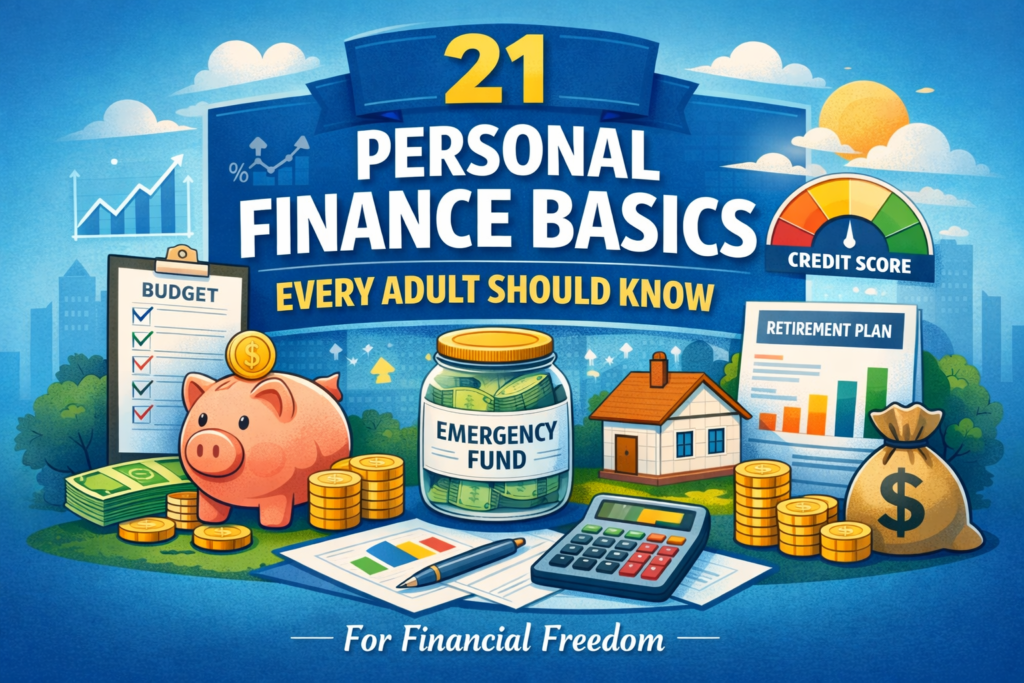
Personal Finance Basics Every Adult Should Know
Money is not complicated, what makes it feel complicated is that most people are introduced to it too late. By the time many adults start paying attention, they are already dealing with debt, financial stress, and poor decisions made without proper understanding.
Personal finance is not about being rich, it is about control. Control over your income, your spending, your future, and your peace of mind. When money is unmanaged, it controls you. When it is understood, it works for you.
Many adults earn regularly and still struggle, not because they are irresponsible, but because they were never taught how money works. They learned how to earn, but not how to manage. How to spend, but not how to plan. As a result, financial instability becomes normal.
If you earn money and do not understand personal finance basics, you are vulnerable to bad debt, lifestyle inflation, and emergencies turning into crises. Income alone does not protect you, structure does.
This guide breaks down the personal finance basics every adult should know to build stability, reduce stress, and create long term financial security. These principles are practical, timeless, and relevant at every income level. Control comes first, everything else follows.
1. Understand Your Net Income, Not Your Salary
Your salary is not your money, your net income is. Net income is what actually enters your bank account after taxes, pension contributions, health insurance, and mandatory deductions. This is the only number that matters when planning your life.
Many adults make financial decisions based on their gross salary and then feel confused when the money never stretches far enough. There is nothing mysterious happening, they are budgeting money they do not actually have. You cannot manage money you never receive, to avoid this mistake, you must be clear about your true monthly income. That means knowing exactly how much hits your account and treating that number as your financial reality.
What to do:
Know the exact amount deposited into your account each month
Do not rely on bonuses until they are paid and consistent
Treat commissions, freelance income, and side income cautiously
If your income is irregular or unstable, your spending must be conservative. There is no safe alternative.
2. Budgeting Is Non Negotiable
If you do not budget, you are guessing and guessing with money almost always ends in stress, debt, or disappointment.
A budget is not a restriction, it is a decision making tool, it tells your money where to go instead of wondering where it went.
Every effective budget answers three simple questions:
How much do I earn?
Where does the money go now?
Where should it go instead?
Budgeting does not mean eliminating enjoyment from your life, it means being intentional. Fun spending is fine when it is planned, unplanned spending is what creates problems.
A simple and effective budget structure includes:
Fixed expenses such as rent, utilities, transport, and insurance.
Variable expenses such as food, data, fuel, and personal spending
Savings and investments
Discretionary spending
If your budget does not include savings, you are not budgeting for progress. You are budgeting to stay stuck.
3. Spend Less Than You Earn or Lose
This is the most basic rule of personal finance and also the most ignored, you cannot out earn bad financial habits. Many high income earners are broke because their spending rises every time their income increases. This is called lifestyle inflation, and it quietly destroys financial progress.
The moment income goes up, expenses chase it, a bigger apartment, a newer car, more subscriptions, more social pressure, more spending justified as reward.
If you spend everything you earn, wealth will never appear, no matter how high your income becomes. What matters is not how much you earn, it is how much you keep and what you do with it.
4. Emergency Funds Are Not Optional
Life does not wait for you to be ready. Illness happens, jobs are lost, family emergencies arise, repairs appear without warning.
If you do not have emergency savings, you will rely on debt, pressure others for help, or make decisions that damage your future.
An emergency fund gives you options, it protects your dignity and prevents short term problems from becoming long term disasters.
How much you need:
At least three months of essential living expenses
Six months or more if your income is unstable or commission based
Where emergency money should be kept:
Easily accessible
Low risk
Separate from investment accounts
Emergency funds are not for growth. They are for protection. Do not confuse emergency savings with investment capital.
5. Debt Is a Tool or a Trap
Debt is not automatically bad, what matters is how it is used. Well managed debt can help you increase income, acquire productive assets, or move forward faster when the terms are reasonable and the plan is clear.
Good debt generally:
Helps increase earning capacity or productivity
Has reasonable interest rates
Has a defined repayment plan
Bad debt usually:
Funds consumption rather than growth
Carries high interest rates
Drags on without clear progress
Credit cards, payday loans, and impulse borrowing quietly damage finances because the pain is delayed while the cost compounds.
If you owe money and do not know the interest rate, minimum payment, or payoff timeline, you are already at risk.
A simple rule applies:
If you cannot pay it off quickly and comfortably, think twice before taking it on.
6. Credit Score Matters More Than You Think
Your credit history follows you quietly, whether you pay attention to it or not.
It affects far more than loan approvals, your credit profile influences interest rates, housing opportunities, and in some cases employment decisions. A weak credit history does not always block access, but it makes everything more expensive.
A poor credit profile costs you money even when you are approved. Higher interest rates mean you pay more for the same things over time.
Protect your credit by practicing basic discipline:
Pay every bill on time, no exceptions
Avoid borrowing unless it serves a clear purpose
Keep balances low relative to your limits
Check your credit reports periodically for errors
Good credit is built slowly through consistency, it can be damaged quickly through neglect. Once damaged, recovery takes time.
7. Saving Is Not the Same as Investing
Saving preserves money, investing grows it. Confusing the two limits your progress.
Many adults keep all their money in savings accounts and assume they are being financially responsible, they are not. Inflation quietly reduces the value of idle money year after year.
Savings are meant for:
Emergencies
Short term goals
Financial stability
Investments are meant for:
Long term growth
Retirement planning
Wealth building
If all your money sits in savings long term, you are falling behind even if your balance increases. Responsible money management requires both saving and investing, each used for the right purpose.
8. Inflation Is the Silent Thief
Inflation reduces your purchasing power every year. The same amount of money buys less over time.
If inflation is higher than the interest earned on your savings, you are losing money in real terms even if your balance grows. This is why investing for the long term matters, inflation punishes inaction and rewards preparation.
Ignoring inflation is financial self sabotage. Your money must grow faster than rising prices or your lifestyle will shrink slowly without warning.
9. Retirement Is Your Responsibility
No one is coming to save you. Governments struggle with funding, pension systems change, employers move on. Relying solely on external support for retirement is risky.
If you do not plan early, you will likely work longer than you want or depend on others later in life. Starting early reduces pressure. Even small contributions invested consistently over time can grow into something meaningful.
Time matters more than amount, delay turns simple planning into painful sacrifice.
10. Compound Interest Works Both Ways
Compound interest is powerful and neutral, it works for you or against you depending on your choices. When you invest early, compounding accelerates growth over time. When you carry high interest debt, compounding accelerates losses.
High interest debt compounds faster than most investments grow. This is why eliminating bad debt often provides a better return than chasing risky opportunities. If you do not understand compounding, it will punish you quietly. If you do, it becomes one of your strongest tools.
11. Insurance Is Risk Management, Not Waste
Many people dislike insurance because they hope nothing bad happens, hope is not a strategy.
Insurance exists to protect against events that can erase years of progress in a single moment.
Insurance helps manage:
Medical costs
Property loss
Income disruption
Liability risks
One major uninsured event can undo years of saving and investing.
Insurance is not exciting. It is protective. Buy what you need. Skip what you do not. The goal is stability, not excess coverage.
12. Track Your Spending Honestly
You cannot fix what you refuse to see, many adults underestimate how much they spend, especially on small daily expenses. These costs feel harmless individually but accumulate quickly.
Track your spending for at least one month, do not judge it, just bserve it. Awareness alone improves behavior, once you see patterns clearly, better decisions follow naturally.
13. Financial Goals Give Direction
Money without direction gets wasted, clear financial goals turn sacrifice into purpose and discipline into progress.
Set goals across different time frames:
Short term goals like clearing debt or building savings
Medium term goals like acquiring assets
Long term goals like retirement or financial independence
Without goals, your money will drift, often it ends up funding other people’s priorities instead of your own.
14. Lifestyle Choices Matter More Than Income
Where you live.
How you commute.
Who you compare yourself to.
These choices influence your finances more than most salary increases ever will. Living below your means is not weakness, it is intelligence. It creates breathing room and reduces stress. Peace is expensive, overspending steals it quietly.
15. Avoid Get Rich Quick Thinking
If something promises fast, guaranteed returns, it is lying.
Wealth is built through:
Consistency
Time
Discipline
Patience
Speculation is not investing, luck is not a plan. Protect yourself from greed disguised as opportunity, most financial disasters start with impatience.
16. Learn Continuously About Money
Money rules change, economies shift, financial tools evolve. Adults who remain financially stable keep learning, they adapt instead of reacting late.
Read, ask questions and improve gradually, ignorance is expensive, and it compounds over time.
17. Your Money Reflects Your Values
Your bank statement tells the truth about your priorities. If your spending does not align with what you claim to value, there is a disconnect worth addressing.
Money is a mirror, use it intentionally or it will expose contradictions you would rather ignore.
18. Financial Independence Is About Freedom
Financial independence does not mean luxury or excess.
It means:
Choice
Stability
Reduced stress
The ability to say no when needed
You do not need extreme wealth to feel free, you need structure, discipline, and time.
19. Mistakes Will Happen. Recover Fast.
Everyone makes financial mistakes, that part is unavoidable.The real danger is repeating the same mistakes because of denial or shame.
Learn from errors, adjust quickly and move forward, shame delays recovery and compounds damage.
20. Start Where You Are
You do not need perfect conditions to begin.
Start with what you can control:
Know your numbers
Spend less than you earn
Build emergency savings
Eliminate bad debt
Invest consistently
Small actions repeated over time create results bigger than dramatic moves made once.
Final Thoughts
Personal finance is not about intelligence, luck, or earning the highest income. It is about behavior, choices, and intentional action. Adults who understand money are not necessarily smarter, they are deliberate in how they earn, spend, save, and invest. They make decisions that protect their present and secure their future.
You can earn a high salary and still feel financially trapped if you lack structure and planning. Conversely, you can earn modestly and thrive financially if you understand the basics and apply them consistently. The difference is not in how much you make, it is in how you manage what you have.
Money is a tool, when used deliberately, it provides freedom, stability, and the ability to make meaningful choices. When ignored, it quietly dictates your life, creating stress, missed opportunities, and regrets you cannot undo.
The best time to start learning personal finance was yesterday, the second best time is now. Every small action you take today, tracking spending, building an emergency fund, paying down debt, investing consistently, and setting financial goals, creates cumulative benefits that grow exponentially over time. Delaying action only makes the work harder later.
Financial control is not achieved overnight, it is built steadily through awareness, discipline, and continuous learning. Treat money as a partner, not a burden, make intentional choices, focus on what you can control, and stay consistent. Over time, the habits you form today will shape the stability, security, and freedom you enjoy tomorrow.
Your journey toward financial mastery starts with understanding, acting, and repeating. Take charge now, because control over your money is the foundation for control over your life.
Related Post:
- How Inflation Affects Your Savings and What to Do: 9 Brutal Truths You Must Know
- 17 Brutal Common Budgeting Mistakes Keeping People Broke in 2026
- 17 Brutal Common Budgeting Mistakes Keeping People Broke in 2026
- How to Build an Emergency Fund Faster: 15 Proven Steps That Actually Work
- Create a Budget That Works in the US & UK: 9 Easy Steps That Save Money
- Personal Finance Guide for Building Wealth in 2026: 18 Proven Strategies That Work