How Investing Works for Complete Beginners: 9 Powerful Steps to Start Building Wealth
Money sitting in a regular bank account rarely grows fast enough to keep up with rising costs of living. Inflation slowly erodes its value, which means the purchasing power of your savings gradually declines over time.
Investing solves this problem, instead of letting money remain idle, investing puts your money to work in assets that have the potential to grow over time. For beginners, the idea of investing can feel intimidating. Markets fluctuate, financial terminology can seem confusing, and the fear of losing money often discourages people from starting.
The truth is much simpler than most people think, investing is not reserved for financial experts or wealthy individuals with the right knowledge and a long-term mindset, almost anyone can start building wealth through investing.
This guide explains how investing works in simple terms, the main types of investments, the risks involved, and how beginners can start safely and confidently.
What Investing Actually Means
Investing is the process of putting money into assets with the expectation that those assets will grow in value over time, instead of allowing money to sit idle, investing gives it the opportunity to generate returns and build wealth gradually.
While saving and investing are both important financial habits, they serve different purposes. Saving focuses on protecting money for short-term needs or emergencies, funds kept in savings accounts are generally stable and easy to access, but they usually grow slowly because interest rates are relatively low.
Investing, on the other hand, is designed for long-term growth, by placing money into assets that can appreciate or produce income, investors allow their wealth to expand beyond what simple savings can achieve.
When you invest, your money is typically used in one of several ways:
1. Buying shares of a company
Purchasing stocks means owning a small piece of a business, as the company grows and becomes more profitable, the value of its shares may rise.
2. Lending money to governments or corporations
When investors buy bonds, they are essentially lending money to an organization. In return, the borrower pays interest over time and eventually repays the original amount.
3. Purchasing assets that may increase in value
Certain assets, such as real estate or commodities, may appreciate over time due to demand, economic growth, or limited supply.
4. Owning diversified investment funds
Funds such as mutual funds or exchange traded funds allow investors to hold many different investments within a single portfolio. These funds often track large sections of the market.
The primary objective of investing is long-term growth. Markets naturally experience short-term fluctuations due to economic changes, global events, or shifts in investor sentiment. However, over long periods, many financial markets have historically trended upward as economies expand and businesses grow.
Understanding this long-term perspective is essential for beginners. Successful investing usually involves patience, discipline, and the ability to stay focused on long-term goals despite temporary market movements.
Why Investing Matters
Many people assume that earning a higher salary is the key to building wealth. While income certainly plays an important role, income alone rarely creates lasting financial security. The real difference often comes from what people do with the money they earn.
Investing transforms savings into assets that can grow over time. Instead of relying solely on active income from work, investments can generate returns that gradually increase your financial resources. This process allows individuals to build wealth more efficiently and create greater financial stability for the future.
There are three major reasons investing plays such a crucial role in long-term financial health.
1. Inflation Reduces the Value of Cash
Inflation refers to the gradual increase in prices across an economy. As the cost of goods and services rises, the purchasing power of money declines.
For example, something that costs $100 today may cost $120 or more in the future. If your money is stored in a low-interest account that grows slowly, it may not keep pace with inflation.
Over time, this means your savings can effectively lose value even though the number in your account appears to remain the same. Investing provides an opportunity to grow money at a rate that may exceed inflation.
By placing funds in assets that historically increase in value, investors can protect and potentially expand their purchasing power over the long term. Without investing, maintaining financial progress can become increasingly difficult as living costs continue to rise.
2. Compounding Accelerates Growth
Compounding is one of the most powerful forces in long-term investing. It occurs when the returns generated by an investment begin producing additional returns of their own.
Rather than earning growth only on the original investment, compounding allows investors to earn growth on both the initial amount and the accumulated gains.
Consider a simple example:
You invest $1,000
The investment grows by 7% in one year
Your balance becomes $1,070
In the following year, the 7 percent return is calculated based on $1,070, not the original $1,000. This means the growth continues building on itself.
Over time, this effect becomes increasingly significant. Small annual gains can compound into large sums when investments remain in the market for many years.
The earlier someone begins investing, the more powerful compounding becomes. Even modest contributions made consistently can grow into substantial wealth when given enough time.
This is why many financial experts emphasize starting early, even if the initial investment amounts are relatively small.
3. Investing Builds Long-Term Financial Independence
Investing allows individuals to gradually build financial resources that extend beyond their regular income.
Rather than relying solely on a paycheck, investors can accumulate assets that produce income, appreciate in value, or both. Over time, these assets can support major life goals and create a greater sense of financial freedom.
Investments can help fund many long-term objectives, including:
Retirement, when regular employment income may stop
Buying a home or upgrading living conditions
Paying for education, either for oneself or family members
Achieving financial independence, where investments generate enough income to support daily living expenses
The key factor that makes investing effective for these goals is time. The longer investments remain active, the greater the potential for growth and compounding.
Even small investments made early in life can grow into meaningful financial support decades later.
The Basic Rule of Investing: Risk and Return
Every investment carries some level of risk, risk refers to the possibility that the value of an investment could decline or fail to meet expectations.
In general, there is a direct relationship between risk and potential return. Investments that offer the possibility of higher returns usually involve greater uncertainty. Investments considered safer tend to produce smaller, more predictable returns.
Understanding this balance is one of the most important lessons for beginners. The goal is not to eliminate risk entirely, which is nearly impossible in investing, but rather to manage risk in a way that aligns with financial goals and personal comfort levels.
Investors often achieve this balance by combining different types of investments within a portfolio.
Low-Risk Investments
Low-risk investments are generally designed to preserve capital and provide steady, predictable income. They are less likely to experience dramatic price fluctuations.
Examples include:
1. High-quality government bonds
Governments issue bonds to raise money for public spending because they are backed by government credit, these bonds are often considered relatively safe.
2. Savings accounts
Traditional savings accounts provide interest on deposited funds. While the returns are usually modest, the money remains accessible and stable.
3. Certificates of deposit (CDs)
These financial products lock money in an account for a fixed period while providing a guaranteed interest rate.
Low-risk investments are useful for protecting money that may be needed in the near future. However, their slower growth means they may not keep pace with inflation over very long periods.
Higher-Risk Investments
Higher-risk investments involve greater uncertainty but also offer the possibility of stronger returns.
Examples include:
1. Stocks
Stock prices can fluctuate based on company performance, market conditions, and economic trends. However, stocks have historically produced strong long-term growth compared to many other asset classes.
2. Cryptocurrencies
Digital assets can experience extreme price swings and are influenced by technological developments, regulation, and market sentiment.
3. Startup investments
Investing in early-stage companies can produce significant gains if the business succeeds, but many startups fail, making this a high-risk category.
While higher-risk investments can produce larger returns, they also require investors to tolerate periods of volatility and potential losses.
For this reason, successful investors rarely place all their money into a single high-risk asset. Instead, they focus on creating a balanced portfolio that spreads risk across multiple investments. Balancing risk and potential reward is one of the core principles that guides long-term investing success.
Major Types of Investments for Beginners
Before starting to invest, it is important to understand the different types of investments available. Each investment category has its own level of risk, potential return, and role within a portfolio.
Beginners do not need to master every investment option immediately. However, having a basic understanding of the most common investment types helps investors make informed decisions and build a balanced strategy.
Below are some of the most widely used investments that beginners should know.
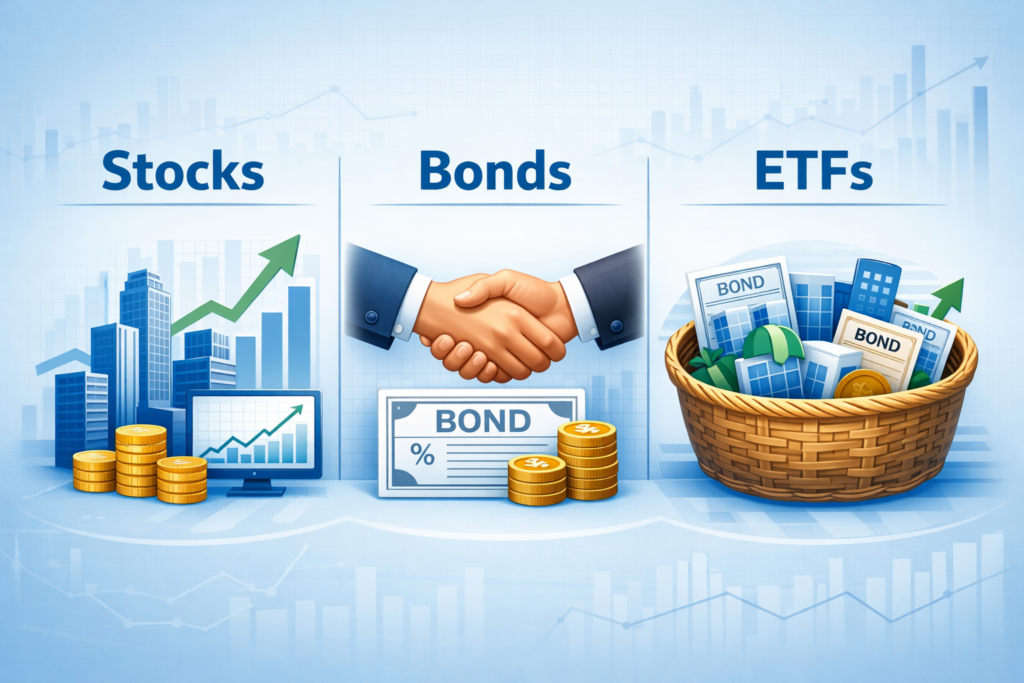
1. Stocks
Stocks represent ownership in a company. When you purchase a stock, you are buying a small share of that business.
Public companies sell shares to raise capital for expansion, research, hiring, and other business activities. In return, investors gain partial ownership and the opportunity to benefit if the company grows successfully.
If the company performs well, earns profits, and expands its operations, the value of its shares may increase. Investors can then sell their shares at a higher price than they originally paid.
Stocks generate returns in two main ways.
- Capital gains
Capital gains occur when the value of a stock rises. If you buy a share for $50 and later sell it for $70, the $20 difference is your capital gain. - Dividends
Some companies distribute a portion of their profits to shareholders in the form of dividends. These payments are usually made quarterly and provide investors with regular income.
Stocks are often considered growth investments because they have historically produced strong long-term returns. However, stock prices can fluctuate significantly in the short term due to economic conditions, company performance, and market sentiment.
Because of this volatility, stocks are generally more suitable for investors with longer time horizons who can tolerate temporary market fluctuations.
2. Bonds
Bonds function differently from stocks. Instead of representing ownership in a company, bonds represent loans made by investors to governments, corporations, or other institutions.
When you purchase a bond, you are essentially lending money to the issuer for a fixed period. In return, the issuer agrees to pay interest at regular intervals and repay the original investment when the bond reaches maturity.
For example, an investor might buy a government bond that pays interest every year for ten years. At the end of the ten-year period, the investor receives the full original investment back.
Because bonds typically provide predictable interest payments and are often backed by large institutions, they tend to be less volatile than stocks. However, this stability usually comes with lower potential returns.
Investors often include bonds in their portfolios to provide stability and reduce overall risk, particularly during periods when stock markets are volatile.
3. Mutual Funds
Mutual funds allow investors to pool their money together to purchase a large and diversified collection of investments.
Instead of buying individual stocks or bonds, investors buy shares in the mutual fund itself. The fund then uses that pooled money to invest in a broad portfolio of assets. For example, a single mutual fund might hold hundreds of different stocks across multiple industries. This structure helps reduce risk because the performance of one company has less impact on the overall investment.
Mutual funds are typically managed by professional fund managers who make decisions about which investments to buy, hold, or sell. Their goal is to achieve the best possible performance for investors based on the fund’s strategy.
One of the biggest advantages of mutual funds is diversification. With a single investment, investors gain exposure to many different assets.
However, mutual funds often charge management fees to cover the costs of professional oversight and administration. Over long periods, these fees can slightly reduce overall returns.
2. Index Funds
Index funds are a specialized type of mutual fund designed to track the performance of a specific market index.
A market index measures the performance of a group of companies that represent a portion of the overall market. Instead of trying to outperform the market, index funds aim to match the performance of the index they track.
For example, some index funds follow large groups of well-established companies across the stock market. Others may track international markets or specific industries.
Because index funds simply mirror the market rather than relying on active management, they typically have lower operating costs. Lower fees mean investors keep more of their investment returns.
Index funds are widely recommended for beginners because they offer several advantages:
Broad diversification
Lower fees compared with actively managed funds
Simplicity and transparency
Reliable long-term market exposure
For many long-term investors, index funds serve as the foundation of a diversified investment portfolio.
3. Exchange Traded Funds (ETFs)
Exchange traded funds, commonly known as ETFs, are similar to index funds in many ways. Both provide diversification by holding a collection of assets within a single investment.
However, ETFs differ in how they are traded, unlike mutual funds, which are priced once at the end of the trading day, ETFs are bought and sold on stock exchanges throughout the day just like individual stocks. This allows investors to trade them more flexibly.
ETFs can track many different types of investments, including:
Broad stock market indexes
Specific industries or sectors
International markets
Bond portfolios
Commodities
Because many ETFs follow index-based strategies, they often have relatively low fees.
For beginners, ETFs offer an efficient way to gain exposure to a wide range of investments without needing to select individual companies.
4. Real Estate
Real estate investing involves purchasing property with the expectation that it will generate income or increase in value over time.
This type of investment can provide both ongoing income and long-term appreciation.
Common real estate investments include:
- Rental properties
Investors purchase residential or commercial properties and earn income from tenants who pay rent. - Real Estate Investment Trusts (REITs): REITs allow investors to buy shares in companies that own or manage income-producing real estate such as apartment complexes, shopping centers, or office buildings.
- Commercial real estate investments: These involve larger properties such as office buildings, hotels, or industrial facilities. Real estate can be an attractive investment because it offers the potential for both income and property value growth. However, direct property ownership often requires significant capital and ongoing management responsibilities. For beginners who prefer a simpler approach, REITs provide an opportunity to invest in real estate without directly managing property.
How the Stock Market Works
The stock market is a marketplace where investors buy and sell shares of publicly traded companies.
When companies first decide to sell shares to the public, they typically do so through a process called an initial public offering. This allows them to raise funds from investors to support business expansion, product development, and other strategic goals.
Once shares become publicly available, they can be traded among investors on stock exchanges. Stock prices change constantly throughout the trading day. These price movements are influenced by several factors, including:
Company earnings and financial performance
Economic growth or recession
Changes in interest rates
Political or global events
Investor expectations and market sentiment
Because of these factors, stock prices can rise or fall quickly over short periods. However, short-term price movements do not always reflect the true long-term value of a company. Investors who focus on long-term trends rather than daily fluctuations often experience more stable outcomes.
The Power of Diversification
Diversification is one of the most important principles in investing. It involves spreading investments across different assets to reduce the impact of any single investment performing poorly.
Instead of putting all your money into one company or one type of asset, diversification distributes investments across multiple opportunities.
A diversified portfolio might include:
Stocks from various industries
Government and corporate bonds
International investments
Real estate funds or REITs
If one sector of the market declines, other investments may perform better and help balance the portfolio.
Diversification does not eliminate risk entirely, but it significantly reduces the chances of a single investment causing major losses. For beginners, diversified funds such as index funds and ETFs make diversification simple and accessible.
Understanding Investment Time Horizons
An investment time horizon refers to how long an investor plans to keep money invested before needing to use it.
Different financial goals require different time horizons, and these timelines influence the types of investments that are most appropriate.
1. Short-Term Goals (1-3 Years):
Short-term financial goals involve money that may be needed relatively soon.
Examples include:
Emergency savings
Planned purchases
Vacations or travel
Upcoming large expenses
Because the money may be required in the near future, these funds are typically kept in safer and more stable financial products such as high-yield savings accounts or short-term bonds.
The focus for short-term goals is preserving capital rather than pursuing aggressive growth.
2. Medium-Term Goals (3-10 Years)
Medium-term goals allow for slightly more investment risk because there is more time to recover from temporary market fluctuations.
Examples include:
Saving for a home down payment
Funding education costs
Building a business reserve fund
Investors pursuing medium-term goals often use balanced portfolios that combine both stocks and bonds. This approach provides growth potential while still maintaining some stability.
3. Long-Term Goals (10+ Years)
Long-term goals offer the greatest opportunity for investment growth because they allow time to absorb market volatility.
Examples include:
Retirement savings
Long-term wealth building
Financial independence
Investors with long time horizons can typically allocate a larger portion of their portfolio to growth-oriented investments such as stocks and equity funds.
Although markets may experience temporary declines, long-term investors benefit from the overall growth of the economy and the compounding of investment returns over time.
Understanding your time horizon helps determine how much risk is appropriate and guides the overall structure of an investment portfolio.
How Beginners Can Start Investing
Many people delay investing because they believe they need a large amount of money to begin. In reality, investing has become far more accessible than it was in the past. With modern financial platforms and a wide range of investment products, beginners can start with relatively small amounts while gradually building their portfolios.
The key is not the size of the initial investment but developing consistent habits and a clear long-term strategy. Most successful investors follow a structured approach that prioritizes financial stability before taking on investment risk.
Below are the essential steps beginners can follow to begin investing confidently.
Step 1: Build an Emergency Fund
Before investing, it is important to establish a financial safety net.
An emergency fund is a reserve of money set aside for unexpected expenses such as medical bills, job loss, urgent repairs, or other financial emergencies. Without this cushion, investors may be forced to sell their investments at unfavorable times in order to cover urgent costs.
Financial experts commonly recommend saving three to six months of living expenses in an easily accessible account. This money should remain stable and readily available rather than invested in assets that fluctuate in value.
Having an emergency fund provides peace of mind and protects long-term investments from being disrupted by short-term financial challenges.
Step 2: Pay Down High-Interest Debt
Before focusing heavily on investing, it is wise to address high-interest debt.
Certain types of debt, particularly credit card balances, can carry extremely high interest rates. In many cases, these rates exceed the returns investors can realistically expect from the market.
For example, if a credit card charges 20 percent interest annually, eliminating that debt effectively provides a guaranteed financial return equivalent to the interest avoided. Reducing or eliminating high-interest debt improves overall financial stability and frees up more income that can later be directed toward investments.
Once expensive debt is under control, investing becomes a much more effective strategy for building wealth.
Step 3: Open an Investment Account
After establishing financial stability, the next step is opening an investment account.
Most investors use brokerage accounts, which allow them to buy and sell various financial assets such as stocks, bonds, mutual funds, and exchange traded funds.
In the past, brokerage accounts often required large minimum balances and charged significant trading fees. Today, many platforms allow beginners to open accounts with minimal initial deposits and offer user-friendly tools designed specifically for new investors.
Modern investment platforms frequently provide features such as:
Educational resources explaining investment concepts
Automated portfolio recommendations
Easy account setup and funding
Access to diversified investment funds
These tools help beginners start investing without needing advanced financial knowledge.
Step 4: Start With Simple Investments
New investors sometimes feel pressured to find the perfect stock or the next big market opportunity. In reality, trying to pick individual winners can be extremely difficult, even for experienced professionals.
For this reason, many beginners start with diversified investments that provide exposure to large portions of the market.
Two common options include:
1. Index funds
These funds track major market indexes and provide exposure to a wide range of companies in a single investment.
2. Broad market exchange traded funds
These ETFs function similarly to index funds but trade throughout the day like individual stocks.
Both options offer several advantages for beginners:
Built-in diversification
Lower fees compared with actively managed funds
Reduced need for constant monitoring or research
Starting with diversified funds allows investors to participate in overall market growth without the pressure of selecting individual companies.
Step 5: Invest Consistently
Consistency is one of the most important habits in successful investing.
Instead of attempting to predict the best moment to invest, many investors follow a strategy known as dollar-cost averaging.
Dollar-cost averaging involves investing a fixed amount of money at regular intervals regardless of market conditions. This could mean contributing money every week, month, or quarter.
When prices are higher, the fixed amount buys fewer shares. When prices are lower, it buys more shares. Over time, this approach spreads out investment purchases and reduces the impact of short-term market fluctuations.
Consistent investing also helps build discipline. Rather than reacting emotionally to market movements, investors continue contributing steadily while allowing long-term growth to unfold.
Common Beginner Mistakes
Investing becomes significantly easier when beginners understand and avoid several common mistakes. Many early setbacks occur not because investing itself is difficult, but because new investors fall into predictable traps.
Recognizing these pitfalls can help beginners develop healthier investment habits from the start.
1. Trying to Get Rich Quickly
One of the most common mistakes is chasing investments that promise rapid profits.
Speculative opportunities often appear attractive because they suggest quick financial gains. However, these investments frequently involve extremely high risk and unpredictable outcomes.
Successful investing usually follows a slower path. Wealth is typically built through steady contributions, long-term growth, and disciplined decision making rather than sudden breakthroughs.
Patience and consistency tend to produce far better results than attempting to capture short-lived market trends.
2. Emotional Investing
Financial markets naturally experience cycles of growth and decline. During periods of market volatility, emotions can strongly influence investment decisions.
Fear may cause investors to sell during downturns, locking in losses. Excitement or hype may encourage buying during periods of rapid price increases.
Both reactions can lead to poor long-term outcomes, maintaining a disciplined strategy helps investors avoid emotional decisions. By focusing on long-term goals rather than daily market movements, investors can stay committed to their overall plan.
3. Lack of Diversification
Placing too much money into a single investment exposes investors to unnecessary risk. If that particular company, sector, or asset class performs poorly, a large portion of the portfolio may suffer significant losses.
Diversification spreads investments across multiple assets so that no single investment has an overwhelming impact on the portfolio. By combining different types of investments, investors create a more balanced and resilient financial strategy.
4. Ignoring Fees
Investment fees may appear small at first glance, but over long periods they can significantly reduce overall returns.
Management fees, trading costs, and other expenses gradually compound over time, lowering the amount of money that remains invested. Low-cost investment funds, particularly index funds and certain ETFs, often provide an efficient solution for long-term investors by minimizing these costs.
Even small reductions in fees can translate into substantial differences in portfolio value over several decades.
The Role of Patience in Investing
Patience is one of the most valuable qualities an investor can develop. Financial markets rarely move in a straight line. Periods of growth are often followed by temporary declines, and market volatility is a normal part of the investing process.
Some of the most successful investors maintain their positions for many years or even decades. Instead of reacting to every market movement, they focus on long-term trends and allow their investments time to grow.
Frequent buying and selling can create unnecessary transaction costs and increase the likelihood of emotional decision making. In contrast, investors who remain committed to their strategy often benefit from the long-term expansion of businesses and economies. Remaining invested during both strong and challenging market periods is often what allows compounding to deliver its full potential.
How Compounding Transforms Small Investments
Compounding allows investment returns to build upon themselves over time. Instead of earning returns only on the initial investment, investors also earn returns on the gains that accumulate along the way. This creates a snowball effect in which growth gradually accelerates.
Even modest investments can grow into significant amounts when compounded over long periods.
Consider the following example:
Monthly investment: $200
Average annual return: 7 percent
Investment period: 30 years
Under these conditions, the investment could grow to more than $240,000. This outcome occurs because each year’s returns generate additional returns in future years.
The earlier someone begins investing, the more powerful compounding becomes. Starting early allows investments to grow across decades, greatly increasing the final result.
Even small contributions made consistently can evolve into substantial wealth over time.
Technology Has Made Investing Easier
Technological advances have dramatically changed the investing landscape.
In the past, investing often required working directly with financial advisors or paying high brokerage commissions. Today, digital platforms have removed many of these barriers.
Modern investment services frequently offer:
Commission-free trading, allowing investors to buy and sell without traditional brokerage fees
Fractional shares, which allow investors to purchase portions of expensive stocks rather than entire shares
Automated investment portfolios, sometimes called robo-advisors, that build and manage diversified portfolios automatically
Educational resources, including tutorials, research tools, and market analysis
These innovations allow beginners to start investing with smaller amounts of money while gaining access to tools that were once available only to professional investors.
Building a Simple Beginner Portfolio
A beginner portfolio does not need to be complicated. In fact, simplicity often leads to better long-term outcomes.
Many investors begin with a basic portfolio structure that combines growth-oriented investments with assets that provide stability.
A simple portfolio might include:
Broad market stock index funds that track large segments of the stock market
International stock funds that provide exposure to companies outside the investor’s home country
Bond funds that help stabilize the portfolio during market fluctuations
The exact balance between these investments depends on several factors, including age, financial goals, and personal tolerance for risk.
Younger investors often allocate a larger portion of their portfolio to stocks because they have many years to recover from market volatility. Investors closer to retirement typically shift toward more stable investments such as bonds.
A balanced portfolio helps manage risk while still allowing long-term growth.
Long-Term Investing vs Trading
Many beginners mistakenly assume that investing and trading are the same activity. While both involve buying and selling financial assets, the underlying strategies are very different.
1. Investing
Investing focuses on long-term growth.
Investors typically purchase assets such as stocks, funds, or bonds and hold them for extended periods. The goal is to benefit from business growth, economic expansion, and the power of compounding.
Rather than reacting to short-term price changes, investors concentrate on the long-term value of their assets.
2. Trading
Trading involves frequent buying and selling of assets in an attempt to profit from short-term price movements.
Traders often analyze charts, technical indicators, and market trends to predict short-term changes in asset prices. This approach requires significant knowledge, constant monitoring of markets, and strong emotional discipline. Even experienced traders can experience losses, and many inexperienced traders struggle to achieve consistent results.
Final Thoughts
Investing does not require advanced financial knowledge or large amounts of money to begin, what matters most is understanding a few core principles and applying them consistently over time.
At its core, investing is simply the process of putting money into assets that have the potential to grow. Stocks, bonds, diversified funds, and real estate give individuals the opportunity to participate in economic growth and build wealth beyond what saving alone can achieve.
Long term success rarely comes from predicting market movements or chasing the next big opportunity. It usually comes from a small set of disciplined habits repeated over many years. Consistent contributions, diversification, low investment costs, and patience form the foundation of most successful investment strategies.
For beginners, the most effective approach is often the simplest one, start with diversified investments, contribute regularly, and allow time for compounding to work. Market fluctuations will happen, but staying focused on long term goals helps investors avoid the mistakes that often derail progress.
If there is one lesson that matters most, it is this: starting early creates a powerful advantage. Even small amounts invested consistently can grow into meaningful wealth when given enough time.
The journey toward financial growth does not begin with a perfect strategy, it begins with taking the first step and allowing time, discipline, and compounding to do the rest.
Recommended Post:
- Beginner’s Guide to Investing Money Safely: 10 Smart Strategies for New Investors
- Net Worth Explained: 7 Simple Steps to Calculate Yours Today
- How Inflation Affects Your Savings and What to Do: 9 Brutal Truths You Must Know
- 17 Brutal Common Budgeting Mistakes Keeping People Broke in 2026
- How Much Cash Should You Keep vs Invest: 7 Smart Strategies for Financial Security
- How to Build an Emergency Fund Faster: 15 Proven Steps That Actually Work