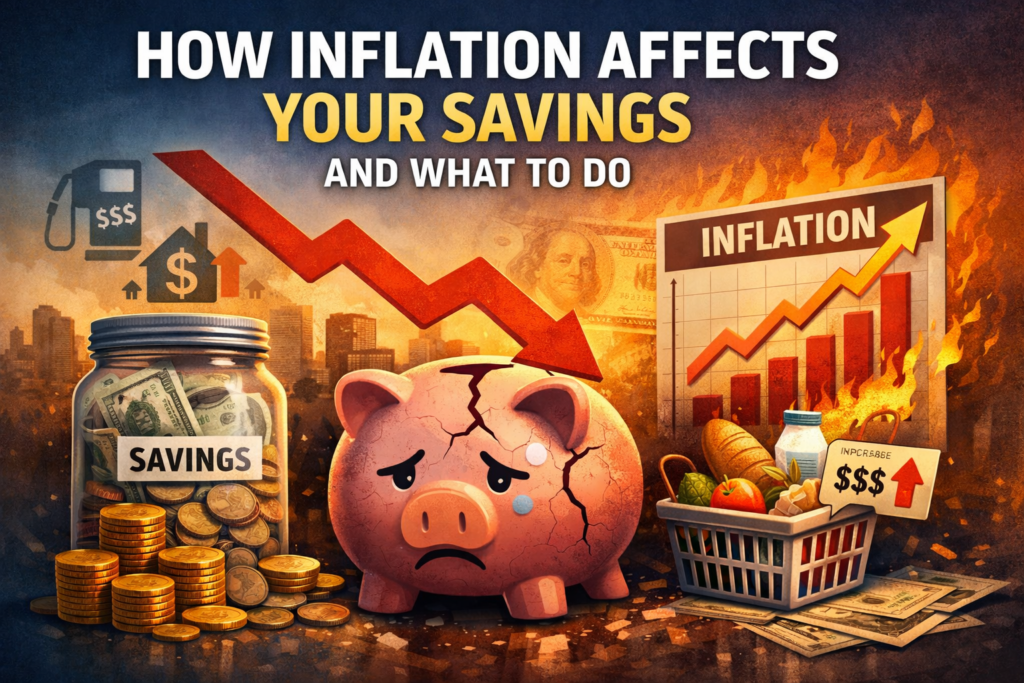
How Inflation Affects Your Savings and What to Do: 9 Brutal Truths You Must Know
Inflation is not loud, it does not announce itself with alarms or warnings, it works quietly in the background, reshaping your financial reality while you are busy earning, saving, and planning for the future.
Most people think inflation only matters when prices suddenly jump at the supermarket or fuel station, that is only the surface. The real damage happens silently, inside your savings account.
Each year, inflation reduces the purchasing power of your money, even when your bank balance stays the same or increases slightly, the value of what that money can actually buy keeps shrinking. Over time, this gap becomes impossible to ignore, this is why people who save consistently can still feel like they are moving backward financially.
The uncomfortable truth is this, saving money alone does not protect you from inflation. In many cases, it exposes you to it. Understanding how inflation affects your savings is no longer optional, it is a basic requirement for long term financial stability.
Ignoring inflation does not make it go away, it guarantees that your money will quietly lose value while you wait.
This article breaks down exactly how inflation eats into your savings, why holding too much cash can be risky, and what practical steps you can take to protect and grow your money in an inflation driven world. If you care about preserving your financial future, this is a conversation you cannot afford to avoid.
What Inflation Really Is
Inflation is the gradual increase in the general price level of goods and services over time. When inflation rises, each unit of currency buys fewer goods and services than it did before, in simple terms, money loses value.
This loss is not theoretical, it shows up in everyday life. Groceries cost more, rent increases, healthcare bills rise, education becomes more expensive. Even small annual increases compound into major financial pressure over time.
For example, if inflation runs at 5 percent per year, something that costs $100 today will cost about $105 next year. In five years, that same item will cost over $127. In ten years, it will be more than $160.
This is the power of compounding working against you. Inflation is influenced by several forces, including:
Growth in the money supply
Demand exceeding supply
Rising production and labor costs
Government fiscal and monetary policy
Central banks like the Federal Reserve attempt to keep inflation moderate, often targeting around 2 percent per year. In theory, this level supports economic growth without severely damaging purchasing power.
In reality, inflation frequently runs higher, especially during periods of economic stress, wars, pandemics, supply chain disruptions, or aggressive stimulus spending. When inflation rises sharply, savers feel the impact first and hardest.
The Silent Destruction of Cash Savings
Cash feels safe, it is liquid, it is predictable, it does not swing up and down like stocks.
But this sense of safety is misleading when inflation is high, if your savings earn less than the inflation rate, you are losing money in real terms even if your account balance increases. The loss is not visible on your bank statement, but it is very real in your daily life.
A Simple Example
Imagine you have $10,000 in a savings account earning 2 percent interest. After one year, your balance grows to $10,200.
Now assume inflation is running at 6 percent, that same basket of goods that cost $10,000 a year ago now costs $10,600.
Despite earning interest, your money can no longer buy what it could before. In real purchasing power, you are $400 poorer, this is how inflation quietly destroys savings.
There is no sudden crash, no dramatic headline, no moment of panic, just slow, steady erosion that compounds year after year until the damage becomes undeniable.
Why Traditional Savings Accounts Fail During Inflation
Most traditional savings accounts were never designed to protect your wealth. They were designed to provide liquidity and short term safety.
Banks use your deposits to lend money at higher rates, you receive a small portion of that return. When inflation rises faster than interest rates, banks protect their margins, savers absorb the loss.
Even in rising rate environments, savings accounts often fail to keep up with inflation because of:
Conservative bank pricing
Slow adjustments to interest rates
Caps on returns for basic accounts
This is why millions of people who save consistently, avoid debt, and follow conventional financial advice still struggle financially decades later.
They did not fail to save, they failed to outpace inflation. Saving alone is not enough.
The Difference Between Nominal and Real Returns
One of the most damaging financial misunderstandings is the focus on nominal returns instead of real returns.
Nominal return is the growth you see on paper, real return is what remains after adjusting for inflation.
If an investment earns 8 percent in a year and inflation is 6 percent, the real return is only 2 percent. If a savings account earns 3 percent while inflation runs at 6 percent, the real return is negative 3 percent.
This distinction matters more than almost anything else in personal finance. What determines your financial security is not how much money you have, it is how much that money can actually buy.
How Inflation Impacts Long Term Goals
Inflation does not only affect your monthly expenses. It reshapes your entire financial future.
1. Retirement
Many people drastically underestimate how much they will need in retirement because they assume today’s costs will remain roughly the same. They will not.
Healthcare, housing, food, and energy costs tend to rise faster than general inflation. A retirement plan that ignores inflation is not conservative. It is unrealistic. Without growth that outpaces inflation, retirement savings lose purchasing power precisely when you need them most.
2. Emergency Funds
Emergency funds are essential, they provide stability, flexibility, and peace of mind. However, oversized emergency funds left in low yield accounts can lose significant value over time, what feels like financial caution can quietly turn into long term erosion.
You need liquidity, but you also need strategy, balancing safety and inflation protection is critical if you want your emergency savings to remain truly useful when you need them.
3. Education and Housing
Education and housing costs rarely follow average inflation, they usually exceed it.
Tuition fees, training programs, professional certifications, and private education costs tend to rise faster than general consumer prices. Housing follows a similar pattern, land is limited, demand grows, and construction costs increase over time. This pushes prices upward even when broader inflation appears stable.
Saving for education or housing purely in cash creates a quiet problem. Each year, the target moves further away. The amount you need grows faster than the money you are setting aside.
This is why many people save diligently for years and still find themselves short when it is time to pay tuition or buy a home. The issue is not discipline, it is strategy.
Why Inflation Hurts the Middle Class the Most
Inflation is often described as a hidden tax, that description is accurate. The wealthy tend to own assets that rise with inflation. Stocks, real estate, private businesses, and commodities often adjust upward as prices increase, their wealth is tied to ownership, not wages.
Lower income groups may receive social support, subsidies, or benefits that partially adjust for inflation. The middle class sits in the most exposed position.
Most middle class wealth is held in wages, savings accounts, pensions, and fixed income instruments, these are the assets most vulnerable to inflation.
When inflation rises:
Wages usually lag behind price increases
Savings lose purchasing power
Debt becomes harder to manage for those without appreciating assets
Over time, this gap compounds. Inflation does not just reduce purchasing power, it reshapes the economic ladder. This is one of the primary ways inflation quietly widens inequality.
Assets That Historically Protect Against Inflation
No asset provides perfect protection but history shows that some assets perform far better than cash during inflationary periods.
1. Stocks
Stocks represent ownership in real businesses. Companies sell products and services, when prices rise, many businesses can raise prices, manage costs, and grow revenues. This ability gives equities long term inflation resistance.
Stock markets are volatile in the short term, that volatility scares people away but over long periods, diversified stock investments have historically outpaced inflation.
The biggest risk is not market movement, it is panic selling. Inflation protection only works if you stay invested.
2. Real Estate
Real estate often benefits from inflation because rents and property values tend to rise over time. Fixed rate mortgage debt becomes easier to manage as inflation reduces the real value of future payments. In simple terms, you repay old debt with cheaper money.
However, real estate is not passive, it is illiquid, requires capital, and demands active management. It can protect against inflation, but it is not effortless.
3. Inflation Protected Bonds
Some governments issue bonds designed to adjust with inflation, such as Treasury Inflation Protected Securities in the United States.
These instruments are designed to preserve purchasing power rather than generate high returns. They can play a stabilizing role in a diversified portfolio, especially for conservative investors.
Their limitation is growth, they protect value but rarely build significant wealth.
4. Commodities and Gold
Commodities and precious metals are often viewed as inflation hedges.
Gold, in particular, has historically been seen as a store of value during periods of currency debasement and monetary instability. However, these assets do not produce income and can experience long periods of stagnation, they are better used as insurance, not as a primary growth engine.
The Role of Central Banks and Policy
Inflation is not random. It is heavily shaped by policy decisions.
Central banks such as the European Central Bank and the Bank of England adjust interest rates and monetary conditions to influence inflation.
When inflation rises, central banks often raise interest rates to slow borrowing and spending. When inflation falls or growth weakens, they may lower rates to stimulate the economy.
These decisions directly affect:
Savings account interest rates
Bond prices and yields
Stock market valuations
Currency strength
This cycle explains why savers are often caught off guard. Policy changes designed to stabilize economies can still punish cash holders, especially during aggressive intervention periods.
Why Doing Nothing Is a Guaranteed Loss
Many people delay financial decisions because they fear making mistakes. They keep money in cash while waiting for clarity, they tell themselves they will act when things settle. This feels responsiblebut it is not.
Inflation does not wait for certainty, every year of inaction locks in a real loss of purchasing power. Doing nothing is not neutral, it is a choice with predictable consequences.
What You Can Do to Protect Your Savings
You do not need complex strategies or constant trading. You need a framework that aligns your money with its purpose.
Step 1: Define the Purpose of Your Money
Not all money should be treated the same way.
Short term expenses need liquidity
Emergency funds need safety and partial inflation protection
Long term goals need growth
Once each dollar has a job, decisions become simpler and more rational.
Step 2: Keep Emergency Cash, but Not Excess Cash
An emergency fund is non negotiable, for most people, three to six months of essential expenses is sufficient. Beyond that point, excess cash becomes a liability, idle money is losing money.
Step 3: Use High Yield Savings and Money Market Accounts
These tools may not fully beat inflation, but they reduce damage compared to traditional savings accounts.
They are best suited for short term needs and emergency reserves, not long term wealth building.
Step 4: Invest for Long Term Growth
Long term savings should be invested in assets that have historically outpaced inflation.
This commonly includes:
Broad stock market index funds
Diversified equity portfolios
Real estate exposure
Consistency matters more than perfection. Time in the market beats waiting for the perfect moment.
Step 5: Increase Your Income Over Time
Inflation protection is not only about where your money sits. It is also about your earning power.
Skills, education, and career growth allow your income to rise alongside inflation, without this, even good investment strategies struggle to keep up. Stagnant income in an inflationary environment is dangerous.
Common Inflation Myths That Hurt Savers
Myth 1: Saving More Fixes Everything
Saving matters, but saving into instruments that lose value only slows the damage. It does not stop it.
Myth 2: Investing Is Too Risky
Not investing is also risky. The difference is that the loss happens quietly.
Myth 3: Inflation Is Temporary
Inflation cycles rise and fall, but long term inflation is a permanent feature of modern economies. Planning as if inflation will disappear is unrealistic.
Psychological Traps Inflation Exploits
Inflation works because it is invisible, people react strongly to sudden market crashes but ignore slow erosion. They fear volatility more than guaranteed loss.
This leads to:
Hoarding cash
Delaying investment decisions
Chasing short term safety
The real danger is not fluctuation, it is stagnation.
Building an Inflation Conscious Financial Plan
An inflation conscious financial plan accepts three realities:
Cash loses value over time
Growth requires exposure to risk
Long term discipline beats short term comfort
Such a plan does not chase extremes, it balances safety and growth, protecting today without sacrificing tomorrow.
Final Thoughts
Inflation is not your enemy simply because it exists, it becomes your enemy the moment you pretend it does not matter.
Every year, your savings face a simple test, either they grow faster than inflation, or they shrink in real terms. There is no neutral outcome, standing still financially is not stability, it is slow decline.
You do not need to predict inflation perfectly to protect yourself. You do not need complex strategies or exotic investments, what you need is awareness of how inflation works, intention in how you structure your money, and the discipline to act consistently.
Cash has an important role, it provides liquidity, flexibility, and security but cash is not the destination. Treating it as one guarantees that time will work against you.
Protecting your savings from inflation is not about being reckless or aggressive, it is about being honest with reality and adjusting your behavior accordingly. Ignoring inflation feels comfortable in the short term but it costs you quietly over the long term.
Understanding inflation changes the game, it turns uncertainty into strategy and fear into informed action.
And in a world where money constantly loses value by default, that understanding is not optional, it is control.
Must Read:
- 17 Brutal Common Budgeting Mistakes Keeping People Broke in 2026
- How Much Cash Should You Keep vs Invest: 7 Smart Strategies for Financial Security
- Top 25 Best High‑Yield Savings Accounts in the US, UK & Canada
- How to Build an Emergency Fund Faster: 15 Proven Steps That Actually Work
- Create a Budget That Works in the US & UK: 9 Easy Steps That Save Money
- Personal Finance Guide for Building Wealth in 2026: 18 Proven Strategies That Work