Beginner’s Guide to Investing Money Safely : 10 Smart Strategies for New Investors
Money sitting idle slowly loses value, inflation quietly erodes purchasing power year after year, and savings accounts alone rarely build meaningful long term wealth. While saving money is important, it is only one part of financial security. Investing is what allows money to grow, outpace inflation, and create opportunities for future financial independence.
Yet for many beginners, the idea of investing feels intimidating, news headlines often highlight stock market crashes, cryptocurrency volatility, and stories of people losing large amounts of money.
Social media can make investing look like a fast paced game of speculation where fortunes are made overnight and lost just as quickly because of this, many people either avoid investing completely or jump in without understanding how it actually works. Both approaches can be costly.
Avoiding investing means missing out on decades of potential growth. On the other hand, rushing into risky investments without a clear strategy can lead to unnecessary financial losses, the reality is far less dramatic than what most people imagine.
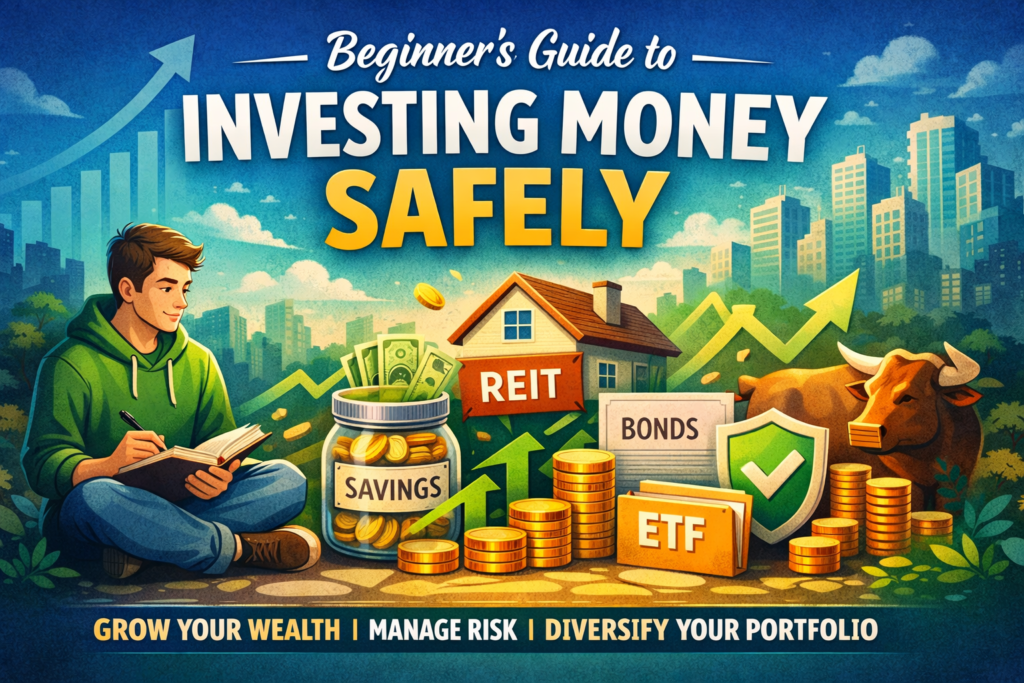
Investing does not have to be reckless, complicated, or reserved only for financial experts. When done correctly, investing can be one of the most reliable ways to build wealth over time. It is not about chasing quick profits or predicting market trends perfectly, instead, safe investing is about managing risk, diversifying assets, and allowing time and compounding to work in your favor.
Safety in investing does not mean eliminating risk entirely, no investment is completely risk free. Rather, safe investing means understanding the risks involved, making informed decisions, and building a strategy designed to protect your money while allowing it to grow steadily.
Many successful investors follow surprisingly simple principles, they invest consistently, keep costs low, diversify their portfolios, and focus on long term growth rather than short term market fluctuations. These habits may not be exciting, but they are effective.
For beginners, the most important step is not finding the perfect investment, it is learning the fundamentals that make investing sustainable and manageable over the long run.
This guide breaks down the essential concepts every beginner should understand before investing money. You will learn how to build a financial safety net, choose safer investment options, manage risk through diversification, and avoid the common mistakes that cause many new investors to lose confidence.
By the end, you will have a clear understanding of how to approach investing safely, even if you are starting with a small amount of money because the truth about investing is simple, you do not need perfect timing, expert predictions, or large sums of money to begin. You just need the right knowledge, a disciplined approach, and the patience to let time do the heavy lifting.
What Investing Actually Means
Investing means putting money into assets that have the potential to grow in value or generate income over time. Instead of allowing your money to sit idle in a standard bank account, investing allows it to work for you.
When money remains in cash savings, it usually earns very little interest. Over time, inflation reduces its purchasing power, meaning the same amount of money buys fewer goods and services in the future. Investing helps counter this effect by allowing your money to grow through market returns and income generating assets.
Investors typically allocate their money into different types of assets, such as:
Stocks
Bonds
Real estate
Index funds
Mutual funds
Exchange traded funds (ETFs)
Each of these assets works differently, but they all share a common purpose: creating the opportunity for financial growth.
For example, when you buy stocks, you purchase a small ownership stake in a company, if the company grows and becomes more profitable, the value of your shares can increase. Some companies also distribute part of their profits to shareholders through dividends.
Bonds operate differently, when you buy a bond, you are essentially lending money to a government or corporation in exchange for interest payments over time.
Real estate can generate income through rent while also increasing in value over the long term. Investment funds, such as index funds and ETFs, allow investors to own a diversified collection of assets within a single investment.
The real power of investing comes from compounding, which allows returns to build upon previous returns.
For instance, if you invest $1,000 in a broad stock market fund and it grows at an average rate of 7 percent annually, your investment could double in roughly 10 years without adding additional money. If you continue investing regularly, that growth accelerates even further.
Over long periods of time, compounding transforms small contributions into significant wealth, this is why investing is widely considered one of the most important tools for building long term financial security.
Why Investing Is Important
Many people assume that saving money alone is enough to achieve financial stability. While saving is essential for short term security and emergencies, it rarely creates lasting wealth on its own.
Without investing, money often grows too slowly to keep up with rising living costs. As a result, individuals may work hard for decades yet struggle to build substantial financial progress.
There are several key reasons why investing plays such an important role in financial health.
1. Inflation Reduces the Value of Cash
Inflation refers to the gradual increase in prices for goods and services over time. As inflation rises, the purchasing power of money decreases.
Even modest inflation can have a significant long term impact, if inflation averages 3 percent per year, the purchasing power of money can decline dramatically over time. In roughly 24 years, money could lose about half of its value.
This means that:
$10,000 today may only buy what $5,000 buys today in the future.
If money remains in low interest savings accounts that earn less than the inflation rate, it effectively loses value every year.
Investing helps protect against this loss by allowing your money to grow faster than inflation. Assets like stocks, real estate, and diversified investment funds have historically produced returns that outpace inflation over long periods.
2. Investing Builds Wealth Through Compounding
Compounding is one of the most powerful forces in finance. It occurs when investment returns generate additional returns over time.
Instead of earning growth only on your initial investment, you begin earning returns on previous gains as well.
Consider this example:
Invest $5,000 per year
Earn an average annual return of 7 percent
Continue investing for 30 years
By the end of that period, the total value of your investments could exceed $470,000.
What makes this especially remarkable is that much of this growth does not come solely from your contributions. A large portion results from the compounding effect of reinvested earnings.
The longer money remains invested, the stronger the compounding effect becomes. This is why starting early can make an enormous difference in long term financial outcomes.
3. Investing Creates Financial Freedom
Another major advantage of investing is the ability to generate income without relying entirely on active work.
Many investments can produce passive income, meaning money continues to flow in even when you are not actively working for it.
Examples include:
Dividends from stocks, which distribute company profits to shareholders
Rental income from property, providing consistent monthly payments
Interest from bonds, offering predictable returns.
Profits from investment funds, which grow as markets expand.
Over time, these income streams can become substantial enough to support financial independence or retirement.
Instead of relying entirely on a paycheck, investments allow your money to contribute to your income. This shift from active income to investment income is one of the foundations of long term financial freedom.
When approached with patience and discipline, investing transforms money from a static resource into a powerful tool for building security, opportunity, and independence.
Step 1: Build a Financial Safety Net First
Before you begin investing, financial stability should come first. Investing without a safety net can create unnecessary risk, especially during unexpected life events.
When people invest money that they might need in the short term, they often end up selling their investments during emergencies. This can be a problem because markets fluctuate, if the market happens to be down when you need the money, you may be forced to sell at a loss.
A strong financial foundation protects you from this situation and allows your investments to grow without constant interruptions. Building that foundation usually involves three essential components.
a) Emergency Fund
An emergency fund is a reserve of money set aside specifically for unexpected expenses. Financial experts commonly recommend saving three to six months of living expenses in an emergency fund. This money should be easily accessible and kept in low risk, liquid accounts such as:
High yield savings accounts
Money market accounts
Unlike investments, emergency funds are not designed for growth, their primary purpose is stability and accessibility.
Unexpected situations can arise at any time. Examples include:
Job loss or sudden income disruption
Medical bills
Car repairs or home maintenance
Family emergencies
Without an emergency fund, people may rely on credit cards or withdraw money from investments prematurely, both choices can create long term financial setbacks.
A well funded emergency reserve provides peace of mind and allows your investment strategy to remain focused on long term growth.
b) High Interest Debt Repayment
Another critical step before investing is eliminating high interest debt, particularly credit card balances.
Credit card interest rates often range between 18 percent and 25 percent, which is significantly higher than the average return most investments generate.
For example, if you invest money while carrying a credit card balance with a 20 percent interest rate, the debt may grow faster than your investments. In effect, you could be losing money even while investing.
Paying off high interest debt provides a guaranteed financial benefit. Unlike market returns, which can fluctuate, eliminating debt instantly improves your financial position. Once high interest debt is under control, investing becomes far more effective and less stressful.
c) Stable Income
A reliable income stream plays an important role in sustainable investing.
Consistent income allows you to contribute regularly to your investments without worrying about withdrawing funds prematurely. It also helps you maintain your emergency savings and handle everyday expenses without relying on debt.
Investing works best when money can remain invested for long periods. Frequent withdrawals disrupt compounding and reduce potential growth. When your financial basics are secure, investing becomes much safer and more strategic.
Step 2: Understand Your Risk Tolerance
Every investment involves some degree of risk. Prices can rise and fall due to economic changes, company performance, interest rates, or global events.
Risk tolerance refers to the amount of uncertainty or volatility an investor is comfortable handling, both financially and emotionally.
Even historically strong markets experience temporary declines. For example, during economic downturns or recessions, the stock market may drop 20 percent or more before eventually recovering.
For some investors, this level of volatility is manageable, for others, it can cause significant stress or lead to panic selling.
Understanding your risk tolerance helps you design an investment strategy that you can realistically maintain during both good and bad market conditions. Several factors influence an individual’s risk tolerance.
a) Age
Age plays a major role in investment strategy, younger investors often have higher risk tolerance because they have many years ahead for their investments to recover from market downturns. This longer time horizon allows them to allocate a larger portion of their portfolio to growth oriented assets such as stocks.
Older investors approaching retirement may prefer more conservative investments that focus on stability and income rather than aggressive growth.
b) Financial Stability
Your overall financial situation also influences how much risk you can take. Someone with strong savings, minimal debt, and stable income can generally tolerate greater market fluctuations. In contrast, someone living paycheck to paycheck may need to adopt a more cautious approach.
Financial security creates flexibility, allowing investors to stay committed to their strategy even during market downturns.
c) Emotional Comfort
Risk tolerance is not only financial, it is also psychological. Some investors remain calm during market declines and view them as normal fluctuations. Others may feel anxious when they see their portfolio temporarily lose value.
Understanding your emotional response to risk is important because emotional decisions often lead to poor investment outcomes. Investors who panic during downturns may sell assets at the worst possible time, locking in losses.
Choosing an investment strategy that aligns with your comfort level increases the likelihood that you will stay disciplined over the long term.
Step 3: Diversify Your Investments
Diversification is one of the most effective ways to manage risk in investing.
Rather than placing all your money into a single investment, diversification spreads your funds across different types of assets. This approach reduces the impact if one investment performs poorly.
Markets are unpredictable, and individual companies or industries can experience unexpected setbacks. Diversification helps ensure that a single failure does not significantly damage your overall portfolio.
Example of Poor Diversification
A common mistake beginners make is investing heavily in a single company. For instance, if all your money is invested in one company’s stock and that company experiences financial trouble, your entire investment could lose a large portion of its value.
Even well known companies can face sudden challenges due to economic changes, competition, or management issues.
Example of Strong Diversification
A diversified portfolio spreads investments across multiple asset types and sectors.
For example, a balanced portfolio might include:
60 percent stock index funds
20 percent bonds
10 percent international funds
10 percent real estate investments
In this structure, different assets respond differently to economic conditions. If one sector struggles, others may perform better and help balance the overall portfolio.
Diversification does not eliminate risk entirely, but it significantly reduces the likelihood of severe losses caused by a single investment.
Step 4: Start With Low Risk Investment Options
Beginners often feel tempted to pursue complex or high risk investments in search of quick profits. However, these strategies can expose new investors to unnecessary volatility and losses.
A safer approach is to begin with investments that have strong historical performance, lower costs, and built in diversification.
1. Index Funds
Index funds are widely considered one of the best starting points for beginner investors.
These funds track a specific market index, which represents a large group of companies. Instead of selecting individual stocks, index funds allow investors to gain exposure to an entire market with a single investment.
This structure provides several advantages:
Built in diversification across many companies
Low management fees compared to actively managed funds
Historically consistent long term performance
Because index funds follow the market rather than trying to outperform it, they tend to have lower costs and fewer risks associated with poor stock selection.
2. Exchange Traded Funds (ETFs)
Exchange traded funds, commonly known as ETFs, operate similarly to index funds but trade on stock exchanges like individual stocks.
ETFs offer several benefits for beginners:
Broad diversification
Lower expense ratios compared to many mutual funds
Flexibility to buy and sell during market hours
Many ETFs track entire markets, global economies, or specific sectors such as technology, healthcare, or energy. This allows investors to build diversified portfolios with relatively small investments.
3. Bonds
Bonds are another important component of many investment portfolios.
When you purchase a bond, you are essentially lending money to a government or corporation in exchange for regular interest payments. At the end of the bond’s term, the original investment is returned.
Compared to stocks, bonds are generally less volatile, while their returns may be lower over the long term, they provide stability and predictable income.
Many balanced portfolios combine stocks for growth and bonds for stability. This combination helps smooth market fluctuations while still allowing investments to grow over time.
Starting with these relatively stable investment options helps beginners build confidence while developing a disciplined long term investment strategy.
Step 5: Avoid Common Beginner Investment Mistakes
Many beginners lose money in the market not because investing itself is dangerous, but because of avoidable mistakes. Poor decisions, unrealistic expectations, and emotional reactions can quickly derail a new investor’s progress.
Understanding these common pitfalls early can protect your money and help you build better habits from the start.
1. Chasing Quick Profits
One of the most common mistakes beginners make is entering the market with the expectation of making fast money.
Stories of overnight success often circulate online, creating the impression that investing is a shortcut to wealth. This mindset frequently pushes new investors toward highly speculative strategies such as:
Day trading
Risky cryptocurrency speculation
Meme stocks driven by online hype
While a few individuals may profit from these strategies, many others experience significant losses. Rapid trading and speculative bets often rely more on luck than sound financial principles.
Safe investing focuses on steady growth over time rather than short term excitement, consistent returns accumulated over many years tend to produce far more reliable results than chasing sudden windfalls.
2. Trying to Time the Market
Another mistake is attempting to predict the perfect moment to buy or sell investments.
Many investors believe they can purchase assets when prices are at their lowest and sell when they peak. In reality, accurately timing the market is extremely difficult, even for experienced professionals.
Markets react to countless unpredictable factors including economic data, geopolitical events, corporate performance, and investor sentiment.
Missing only a few of the market’s strongest days can dramatically reduce long term returns. Because those strong days often occur during volatile periods, investors who stay out of the market while waiting for the “perfect time” frequently miss critical opportunities for growth.
A more reliable approach is consistent investing over time, regardless of short term market conditions.
3. Lack of Diversification
Concentrating investments in a single asset or company significantly increases risk.
If that one investment performs poorly, your entire portfolio may suffer severe losses. This situation can occur even with companies that once appeared stable or dominant in their industry.
Diversification spreads investments across different sectors, asset types, and geographic regions. This approach reduces the likelihood that a single negative event will severely damage your overall portfolio. For beginners especially, diversified investment funds such as index funds and ETFs provide a simple and effective way to achieve this balance.
4. Emotional Investing
Emotions are one of the biggest threats to long term investment success.
During market downturns, fear may cause investors to panic and sell assets at low prices. When markets rise rapidly, greed can push investors to buy aggressively at inflated prices.
Both reactions often lead to poor outcomes, successful investors focus on discipline rather than emotion. They follow a strategy, maintain diversification, and remain committed to long term goals even when markets experience short term turbulence.
Learning to manage emotional reactions is one of the most valuable skills an investor can develop.
Step 6: Use Dollar Cost Averaging
Dollar cost averaging is a simple strategy that helps investors manage market volatility while building consistent investing habits.
Instead of trying to predict the best moment to invest a large amount of money, this approach involves investing a fixed amount at regular intervals regardless of market conditions.
For example:
Invest $200 every month
Continue investing whether the market is rising or falling
Over time, this strategy spreads your purchases across different market prices. Dollar cost averaging offers several important advantages.
a) Reduces Market Timing Risk
Trying to predict the perfect time to invest can lead to delays and missed opportunities.
With dollar cost averaging, you remove the pressure of timing the market. Investments continue consistently, allowing you to participate in both market dips and market growth.
b) Encourages Discipline
Automatic or scheduled contributions make investing a regular habit rather than a decision influenced by emotions or news headlines.
This consistency helps investors stay committed to their long term strategy.
c) Smooths Price Volatility
Because you invest the same amount regularly, you naturally buy more shares when prices are low and fewer shares when prices are high.
Over time, this can reduce the average price you pay for investments, helping stabilize returns across changing market conditions.
Step 7: Keep Investment Costs Low
Investment fees may seem small at first, but over time they can significantly reduce the value of your portfolio.
Even modest annual fees compound over decades, quietly eroding long term returns.
For example, a 1 percent annual management fee may appear insignificant. However, over a 30 year investment period, that fee could reduce the final value of your portfolio by tens of thousands of dollars.
Minimizing unnecessary costs is therefore an important part of safe investing.
1. Focus on Low Cost Funds
Many experienced investors favor low cost index funds and ETFs because they offer broad market exposure at minimal expense.
These funds track market indexes rather than relying on expensive fund managers to actively select stocks. As a result, their expense ratios are often significantly lower than those of actively managed funds.
Lower costs mean more of your investment returns remain in your portfolio instead of being lost to fees.
2. Avoid Frequent Trading
Frequent buying and selling of investments can create additional costs, including transaction fees and potential tax consequences.
Constant trading also increases the likelihood of emotional decisions based on short term market movements. Long term investing typically produces better outcomes because it allows compounding to work uninterrupted while minimizing unnecessary expenses.
Step 8: Think Long Term
One of the most important principles of safe investing is maintaining a long term perspective.
Financial markets move up and down constantly. Short term volatility is a normal part of investing, and temporary declines occur even in strong economies. Throughout history, markets have experienced numerous disruptions, including:
Economic recessions
Financial crises
Political instability
Global pandemics
Despite these challenges, markets have historically trended upward over long periods. Investors who remained patient and stayed invested often recovered from downturns and continued to grow their wealth.
Attempting to react to every market fluctuation can lead to unnecessary stress and poor decisions. A long term mindset allows investors to focus on gradual growth rather than short term noise.
Patience is one of the greatest advantages an investor can have.
Step 9: Rebalance Your Portfolio
As investments grow over time, the balance of your portfolio may shift away from its original structure.
Different asset classes grow at different rates. For instance, stocks may rise rapidly during strong economic periods while bonds grow more slowly and steadily. If one asset grows significantly faster than others, it can change the overall risk level of your portfolio.
For example:
Original portfolio
60 percent stocks
40 percent bonds
After several years of market growth
75 percent stocks
25 percent bonds
In this scenario, your portfolio has become more heavily weighted toward stocks, increasing its overall risk.
Rebalancing restores your intended investment allocation, this usually involves selling a portion of assets that have grown beyond their target percentage and reinvesting the proceeds into assets that are underrepresented.
Many investors review and rebalance their portfolios once or twice per year to maintain their desired risk level.
Step 10: Continue Learning
Investing is not a one time decision but an ongoing process. Financial markets evolve, economic conditions change, and new investment opportunities continue to emerge.
Continuous learning helps investors make informed decisions and avoid costly mistakes.
Over time, you may want to explore topics such as:
Portfolio allocation strategies
Tax efficient investing
Retirement planning
Global economic trends
Advanced diversification techniques
The more knowledge you gain, the better equipped you will be to manage risk and refine your investment strategy.
Investing successfully does not require constant trading or complex predictions. It requires patience, discipline, and a commitment to improving your financial understanding over time.
For beginners, building that knowledge gradually is one of the safest and most valuable investments you can make.
Safe Investing Does Not Mean Zero Risk
A common misunderstanding among new investors is the belief that safe investing means avoiding risk entirely. In reality, no investment is completely risk free. Every asset carries some level of uncertainty, whether it involves market fluctuations, economic conditions, or changes in interest rates.
Even investments that are historically considered stable can experience temporary losses. Stock markets occasionally decline during recessions, bond prices can fluctuate when interest rates change, and real estate markets may slow during economic downturns.
However, the presence of risk does not mean investing is inherently dangerous. Safe investing is not about eliminating risk. Instead, it focuses on managing risk intelligently so that no single event or market movement can significantly damage your financial progress. Effective risk management usually involves several key principles.
1. Diversifying Assets
Diversification spreads your investments across different asset classes, industries, and geographic regions. This reduces the impact if one particular investment performs poorly.
A diversified portfolio might include stocks, bonds, and other investment funds rather than concentrating money in a single company or sector.
2. Investing Consistently
Regular investing helps smooth market volatility. By investing over time instead of trying to predict market movements, investors can reduce the impact of short term price swings.
Consistency also strengthens long term compounding, which is a major driver of investment growth.
3. Avoiding Speculation
Speculative investments promise rapid gains but often carry extremely high risk. Many beginners are drawn to trends or popular online investment hype without understanding the underlying risks.
Safe investing focuses on well established assets and long term strategies rather than chasing unpredictable opportunities.
4. Maintaining Long Term Discipline
Markets naturally experience ups and downs. Investors who react emotionally to every fluctuation may buy or sell at the wrong moments.
Maintaining discipline during both market booms and downturns is essential for long term success. Investors who stay focused on their strategy often benefit when markets eventually recover and continue growing.
When these principles are followed, investing becomes far less risky than many people assume. In fact, over long periods of time, avoiding investing entirely may carry greater financial risk because inflation steadily erodes the value of idle money.
How Much Money Should Beginners Start With?
Another common misconception is that investing requires large amounts of money. Many people delay investing because they believe they must accumulate thousands of dollars before getting started.
In reality, modern investment platforms have made investing far more accessible, many brokerages and investment apps allow beginners to start with relatively small amounts of money. In some cases, investors can begin with contributions such as:
$50 per month
$100 per month
$200 per month
While these amounts may seem small, the key factor in successful investing is not the size of the initial contribution. What matters most is consistency over time.
Regular contributions allow investments to grow steadily while benefiting from compounding. Even modest monthly investments can accumulate into significant sums when maintained for many years.
Starting small also helps beginners develop confidence and discipline. As income grows or financial stability improves, contributions can gradually increase.
The most important step is simply getting started, waiting for the “perfect” moment or a large amount of money often leads to years of missed opportunities. Beginning early, even with small contributions, allows compounding to begin working in your favor.
The Power of Time in Investing
Time is one of the most powerful advantages an investor can have. The longer money remains invested, the more opportunity it has to grow through compounding.
Compounding occurs when investment returns generate additional returns over time. Instead of growth occurring only on your original investment, your gains also begin producing their own gains.
This effect becomes increasingly powerful as time passes, consider the following example involving two investors.
Investor A
Starts investing $200 per month at age 25
Investor B
Starts investing $400 per month at age 35
Although Investor B contributes twice as much money each month, Investor A begins investing ten years earlier. Those additional years allow compounding to work for a longer period.
As a result, Investor A may ultimately accumulate more wealth despite contributing less money each month.
This example highlights one of the most important lessons in investing, starting early can be more valuable than investing larger amounts later.
Time allows investments to recover from short term market fluctuations and benefit from decades of gradual growth.
For beginners, this means the safest strategy is often the simplest one. Start investing as early as possible, contribute consistently, and allow time and compounding to do most of the work.
Final Thoughts
Safe investing is not about eliminating risk, it’s about managing it intelligently while giving your money the opportunity to grow steadily over time. Every investment carries some degree of uncertainty, but when approached thoughtfully, investing becomes a powerful tool for building financial security and long term wealth.
For beginners, success starts with a strong foundation, establish an emergency fund, pay down high interest debt, and ensure a stable income before you commit significant funds to the market. From there, focusing on diversified portfolios, low cost investments, and long term discipline dramatically improves your chances of achieving consistent growth without unnecessary stress.
Avoid chasing quick profits, short term market fluctuations can tempt even experienced investors to make emotional decisions, but reacting to daily headlines rarely leads to lasting gains. Instead, focus on regular contributions, maintaining your strategy, and letting compounding work over time. Patience is one of the most powerful advantages in investing; wealth grows gradually, not overnight.
Starting small is perfectly fine, contributing even modest amounts consistently is more effective than waiting until you can invest large sums. Starting imperfectly is also acceptable, the key is simply to begin. Time in the market is more important than timing the market.
Remember, the most costly mistake in investing is delaying your start. Every month you wait is potential growth lost to inflation and missed compounding opportunities, take the first step today, however small, and commit to learning and improving as you go.
Investing is not a sprint, it’s a marathon. Those who approach it with patience, discipline, and consistent action often find that financial security and wealth are not just goals, but outcomes of a thoughtful, long term strategy.Start now, your future self will thank you.
Must Read:
- Net Worth Explained: 7 Simple Steps to Calculate Yours Today
- 10 Smart Ways to Track Expenses Without Feeling Restricted and Still Enjoy Life
- 21 Personal Finance Basics Every Adult Should Know for Financial Freedom
- How Inflation Affects Your Savings and What to Do: 9 Brutal Truths You Must Know
- 17 Brutal Common Budgeting Mistakes Keeping People Broke in 2026
- How Much Cash Should You Keep vs Invest: 7 Smart Strategies for Financial Security