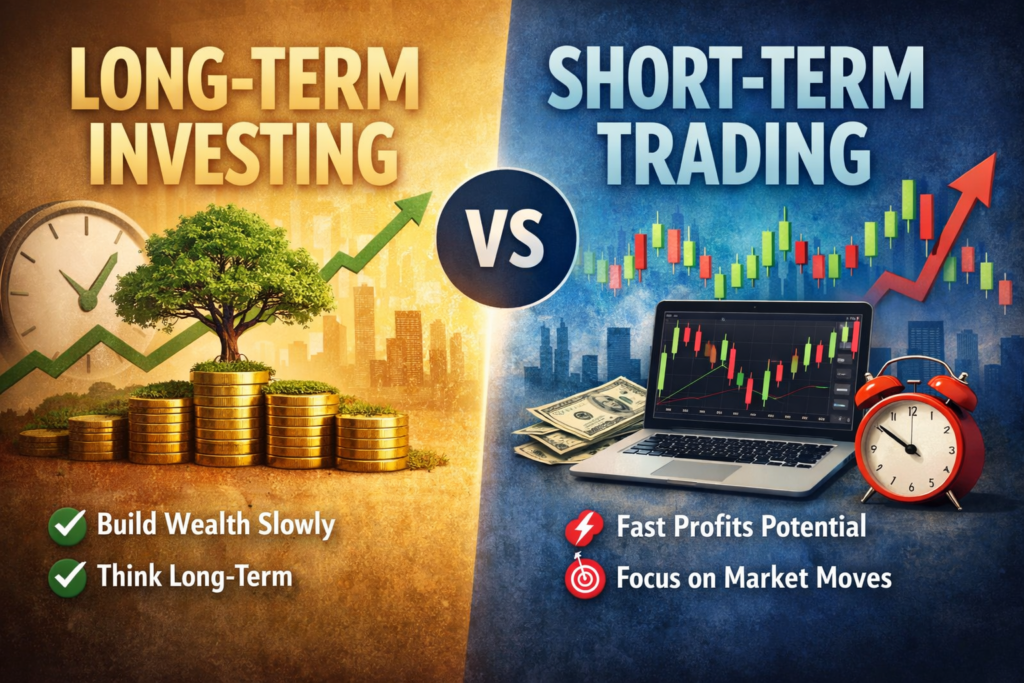
Long-Term Investing vs Short-Term Trading: 7 Powerful Differences Every Investor Must Know
Many people enter the financial markets with the goal of growing their wealth as quickly as possible. Some take the long-term investing route, focusing on patience and steady growth, while others prefer short-term trading, aiming to profit from rapid market movements. Both strategies can be profitable, but they require very different mindsets, skills, and levels of risk tolerance.
Choosing between these two approaches is one of the most important decisions any investor or trader will make. The strategy you follow can influence how much time you spend analyzing the market, how you react to volatility, and how consistent your results may be over time.
Understanding the differences between long-term investing and short-term trading is essential before committing your money to the market. In this guide, we will explore how each strategy works, the key differences between them, their potential risks and rewards, and which approach may align best with your financial goals.
What Is Long-Term Investing?
Long-term investing involves buying financial assets and holding them for an extended period, typically several years or decades. The primary goal is to build wealth gradually as investments grow through market appreciation, dividend income, and the power of compounding.
Rather than reacting to daily market movements, long-term investors focus on the broader trend of economic growth and business expansion. Historically, financial markets have tended to rise over long periods despite short-term volatility. By staying invested through market cycles, investors allow their portfolios time to recover from downturns and continue growing.
Long-term investors commonly build portfolios using assets such as individual stocks, index funds, exchange-traded funds (ETFs), mutual funds, and retirement accounts. The emphasis is usually on diversification and selecting investments with strong long-term potential.
This strategy rewards patience and discipline. Instead of trying to predict short-term price movements, long-term investors focus on the underlying strength of businesses and the overall direction of the market.
Key Characteristics of Long-Term Investing
1. Extended holding periods
Long-term investors typically hold assets for five years or more, and many keep investments for decades. This long time horizon allows investments to grow and smooth out the effects of short-term market fluctuations.
2. Focus on fundamentals
Investment decisions are usually based on fundamental analysis. Investors evaluate factors such as company earnings, revenue growth, competitive advantages, management quality, industry trends, and long-term business prospects.
3. Compounding returns
One of the most powerful aspects of long-term investing is compounding. When dividends and capital gains are reinvested, they generate additional returns over time. As the investment grows, the compounding effect accelerates wealth accumulation.
4. Lower transaction frequency
Long-term investors trade less frequently than traders. Fewer transactions reduce brokerage fees, limit tax liabilities, and help prevent emotional decision-making during periods of market volatility.
Example of Long-Term Investing
Consider an investor who puts $10,000 into a broad market index fund and holds the investment for 20 years while reinvesting dividends. Over time, the combination of market growth and compounding returns can significantly increase the value of the original investment.
The key principle behind this approach is patience. Long-term investors rely on time in the market rather than constant trading activity.
What Is Short-Term Trading?
Short-term trading focuses on generating profits from price movements that occur within shorter time frames. These trades can last minutes, hours, days, or sometimes a few weeks.
Instead of relying on long-term business growth, traders attempt to profit from short-term changes in market sentiment, technical patterns, and price momentum.
Because price movements can occur quickly, short-term traders often rely on technical analysis rather than fundamental analysis. They study charts, indicators, and price patterns to identify potential entry and exit points.
Several trading styles fall under short-term trading, including:
Day trading, where positions are opened and closed within the same day
Swing trading, which involves holding trades for several days or weeks
Scalping, where traders aim to capture very small price movements repeatedly
Momentum trading, which focuses on stocks moving strongly in one direction
Short-term trading requires faster decision-making and closer monitoring of market activity compared with long-term investing.
Key Characteristics of Short-Term Trading
1. Frequent buying and selling
Short-term traders may execute dozens or even hundreds of trades in a single month. The goal is to capture small price movements multiple times.
2. Heavy reliance on technical analysis
Charts, indicators, support and resistance levels, and trading patterns play a central role in decision-making. Traders often use tools such as moving averages, trend lines, and volume indicators.
3. Higher time commitment
Active trading requires regular monitoring of market conditions. Many traders spend hours analyzing charts, following news events, and managing open positions.
4. Greater emotional pressure
Rapid market movements can create emotional stress. Traders must remain disciplined and follow strict risk management rules to avoid impulsive decisions.
Example of Short-Term Trading
A trader may identify a stock showing strong upward momentum and buy it at $50. If the price quickly rises to $52 within the same day, the trader may sell to capture the short-term gain.
While the profit from a single trade may appear small, traders attempt to repeat this process many times, aiming to accumulate consistent gains over time.
7 Major Differences Between Long-Term Investing and Short-Term Trading
1. Time Horizon
The most obvious difference between these two strategies is how long positions are held.
Long-term investing
Investments are held for years or even decades. The goal is to benefit from long-term market growth and compounding returns.
Short-term trading
Positions are typically held for minutes, hours, days, or a few weeks. Traders focus on short-term price movements rather than long-term business performance.
Because of these different time horizons, the strategies used to analyze opportunities and manage risk also differ significantly.
2. Risk Level
Both approaches involve risk, but the nature of the risk is different.
Long-term investing risks
Long-term investors face risks such as market downturns, economic recessions, and company-specific problems. However, a longer time horizon provides opportunities for recovery after temporary losses.
Short-term trading risks
Traders face sudden price swings, unexpected news events, and high market volatility. Because trades are held for shorter periods, there is less time for prices to recover if a trade moves in the wrong direction.
Effective risk management is essential for traders to limit potential losses.
3. Potential Returns
Both strategies can produce profits, but the way returns are generated is different.
Long-term investors
Returns come primarily from long-term market growth, dividend payments, and compounding. Over time, reinvested earnings can significantly increase portfolio value.
Short-term traders
Traders attempt to generate profits from small price movements. By executing multiple successful trades, they aim to accumulate gains over shorter periods.
However, achieving consistent trading profits requires skill, discipline, and experience.
4. Time Commitment
The amount of time required for each strategy varies greatly.
Long-term investing
Investors usually spend less time managing their portfolios. After selecting investments, they may only review their holdings periodically, such as quarterly or annually.
Short-term trading
Active trading requires much more attention. Traders often monitor charts, news events, and price movements throughout the trading day.
For individuals with demanding schedules or full-time jobs, long-term investing may be easier to maintain.
5. Transaction Costs
Trading frequency directly affects costs.
Long-term investing
Fewer transactions mean lower brokerage fees and fewer taxable events. This allows more capital to remain invested and continue growing.
Short-term trading
Frequent buying and selling leads to additional costs, including brokerage commissions, bid-ask spreads, and potentially higher tax liabilities.
Over time, these costs can significantly reduce overall profitability.
6. Emotional Stress
Short-term trading tends to create higher emotional pressure.
Traders must make quick decisions while markets move rapidly. Fear, greed, and the fear of missing out can lead to poor decisions if emotions are not controlled.
Common psychological challenges include:
Fear of missing profitable opportunities
Panic selling during sudden price drops
Overtrading after experiencing losses
Long-term investors usually face less day-to-day stress because they focus on long-term market trends rather than short-term fluctuations.
By maintaining a long-term perspective, investors can avoid reacting to temporary market noise and remain focused on their overall financial goals.
7. Knowledge and Skill Requirements
Both long-term investing and short-term trading require financial knowledge, but the focus areas differ significantly.
Long-term investors typically focus on:
Financial statements: Understanding revenue, profits, and cash flow to evaluate company health.
Business models: Assessing how a company generates revenue and sustains growth.
Economic trends: Evaluating macroeconomic factors that affect industries and markets over years.
Diversification: Spreading investments across sectors and asset classes to reduce risk.
Short-term traders focus on:
Technical indicators: Using moving averages, RSI, MACD, and other tools to predict price movement.
Chart patterns: Recognizing trends, support/resistance levels, and candlestick formations.
Trading psychology: Controlling emotions like fear and greed that can disrupt decision-making.
Risk management: Setting stop losses, position sizes, and limits to protect capital.
Mastering short-term trading often requires more practice and a higher learning curve, as profits depend on quick, precise decisions in volatile markets.
Advantages of Long-Term Investing
Long-term investing is widely recommended for building wealth sustainably.
1. Power of Compound Growth
By reinvesting dividends and capital gains, your investments earn returns on returns. Over time, this accelerates wealth accumulation and can dramatically increase portfolio value.
2. Lower Stress
Long-term investors are less affected by daily market fluctuations. Monitoring portfolios periodically is sufficient, making this approach easier to manage mentally.
3. Lower Costs
Fewer trades mean reduced brokerage fees and lower taxes. More of your money remains invested, letting it grow uninterrupted.
4. Historical Market Growth
Over decades, global markets generally trend upward despite recessions or temporary downturns. Long-term investors benefit from this steady growth.
Advantages of Short-Term Trading
Short-term trading can offer distinct opportunities for active investors.
1. Faster Potential Profits
Traders do not need to wait years for returns. Profits can be realized in days or even hours.
2. Opportunities in Volatile Markets
Price swings and market volatility create chances to profit from both rising and falling markets.
3. Flexibility
Short-term strategies can quickly adapt to changing market conditions, news events, or sector shifts.
Disadvantages of Long-Term Investing
Despite its benefits, long-term investing has limitations:
1. Slower Wealth Growth
Returns accumulate gradually, which may feel frustrating for investors seeking quick gains.
2. Exposure to Market Downturns
Portfolios can temporarily decline during recessions or market corrections.
3. Requires Discipline
Investors must resist the urge to sell during market panic or sharp declines to avoid locking in losses.
Disadvantages of Short-Term Trading
Short-term trading carries higher risks and challenges:
1. High Failure Rate
Many beginners lose money due to poor strategy, overtrading, or emotional decisions.
2. Requires Constant Attention
Successful trading demands hours of daily analysis, monitoring charts, and tracking news.
3. Emotional Pressure
Rapid losses or missed opportunities can lead to impulsive decisions that compound losses.
4. Higher Taxes
Frequent trades can trigger short-term capital gains taxes, reducing net profits compared to long-term holdings.
Which Strategy Is Better for Beginners?
For most beginners, long-term investing is the safer starting point. Benefits include:
Lower stress and emotional pressure
Fewer mistakes caused by impulsive decisions
Reduced trading costs
Minimal daily time commitment
Short-term trading can be pursued later, once investors gain market experience, confidence, and the skills required to manage risk effectively. Some people enjoy the fast pace and challenge, but it requires dedication and practice.
Can You Combine Both Strategies?
Many investors adopt a hybrid approach:
Core Portfolio:
A diversified long-term portfolio of index funds, dividend stocks, or ETFs that forms the foundation for steady wealth growth.
Trading Portfolio:
A smaller portion of capital dedicated to short-term trades for profit opportunities.
This method allows investors to balance stability with active profit potential, minimizing risk while capturing market opportunities.
Tips for Choosing the Right Strategy
Choosing the best approach depends on your personal circumstances:
Define Your Financial Goals
Long-term goals like retirement favor long-term investing. Short-term trading may suit those seeking more immediate engagement with the market.Evaluate Your Risk Tolerance
Trading involves higher volatility and potential losses; investing is generally more forgiving.Consider Your Time Commitment
If you cannot monitor markets regularly, long-term investing is more practical.Start Small
Whether investing or trading, begin with smaller amounts to learn and minimize risk.Focus on Education
Knowledge of financial markets, risk management, and investment strategies increases your chances of long-term success.
Common Mistakes Investors Make
Even experienced market participants can make costly errors:
Trying to Time the Market: Predicting short-term movements consistently is extremely difficult.
Overtrading: Frequent trades increase costs and reduce profitability.
Ignoring Diversification: Concentrating investments in a few assets increases risk exposure.
Emotional Investing: Fear and greed often lead to poor decision-making and losses.
By understanding these pitfalls and committing to a disciplined approach, investors and traders can improve outcomes and reduce unnecessary risk.
Final Thoughts
Long-term investing and short-term trading are two very different ways to build wealth in the financial markets.
Long-term investing focuses on patience, compounding, and steady growth over time. Investors rely on strong businesses and long-term market trends rather than daily price movements. This approach usually requires less time, lower costs, and less emotional pressure.
Short-term trading, in contrast, aims to profit from short-term price changes, while it can produce faster gains, it demands more time, stronger technical skills, and strict risk management. The pace is faster, and the risks can be higher.
For most people, long-term investing offers a more stable and sustainable path to building wealth. However, traders who develop discipline and effective strategies can also find opportunities in short-term market movements.
The key is choosing a strategy that aligns with your financial goals, risk tolerance, and available time. Regardless of the approach you take, consistency, patience, and continuous learning remain essential for long-term success in the markets.
Related Post:
- How Risk Tolerance Affects Your Investment Choices: 9 Powerful Strategies Smart Investors Use
- Dollar Cost Averaging Explained: 7 Powerful Examples to Master This Smart Investing Strategy
- Index Funds Explained: 9 Powerful Reasons They Beat Most Investors
- 7 Smart Ways to Start Investing With $100 or Less Today
- Stocks vs Bonds vs ETFs: 7 Powerful Differences Every Beginner Must Understand
- How Investing Works for Complete Beginners: 9 Powerful Steps to Start Building Wealth