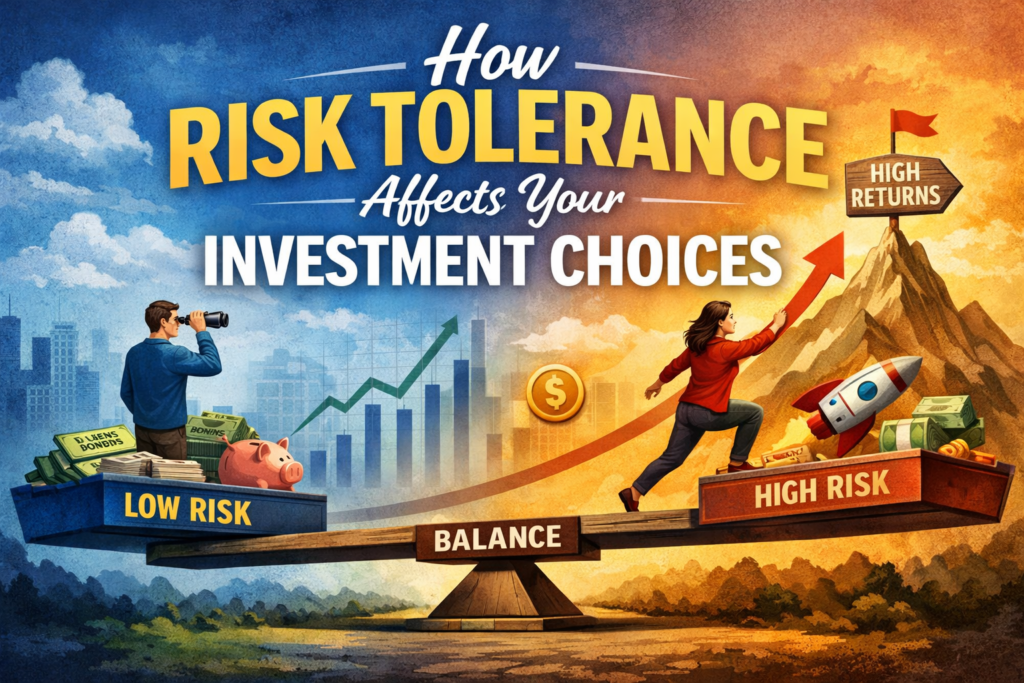
How Risk Tolerance Affects Your Investment Choices
Investing is often painted as a straightforward decision, choose between stocks, bonds, or funds, and watch your money grow but anyone who’s tried it knows the reality is far more nuanced.
The true force shaping your portfolio isn’t the market, it’s your own comfort with risk. Imagine two friends, both earning the same salary, both with identical savings, and both presented with the same investment opportunities. One dives into growth stocks with confidence, while the other sticks to bonds and dividend-paying companies. Years later, their portfolios look completely different.
What caused the divergence? Risk tolerance, how much uncertainty, volatility, and potential loss each person is willing to accept to achieve higher returns.
Understanding your risk tolerance isn’t just about knowing what investments “feel right.” It’s about building a strategy that aligns with your financial goals, your timeline, and your emotional comfort level. Without it, even the smartest investment plans can crumble under the weight of market swings, leading to impulsive decisions and lost opportunities.
This guide will break down what risk tolerance really means, why it’s essential, and how it directly shapes the choices investors make every day, so you can create a portfolio that not only grows wealth but also lets you sleep well at night.
What Risk Tolerance Means in Investing
Risk tolerance is simply your ability and willingness to handle fluctuations in the value of your investments. Every investment carries some level of uncertainty, whether it’s a blue-chip stock, a government bond, or a diversified fund. Even the most stable assets can experience short-term ups and downs.
Your risk tolerance determines how comfortable you feel when these swings occur. Investors with high risk tolerance can accept larger short-term losses for the chance of higher long-term gains. Those with lower risk tolerance typically prioritize stability and predictability, even if it means slower growth.
Understanding your personal risk threshold is crucial because it influences nearly every investment decision, including:
How much of your portfolio is allocated to stocks versus bonds
Whether you choose growth-oriented companies or steady dividend payers
How you react when markets decline
The balance between pursuing higher returns and protecting your capital
When your investments align with your risk tolerance, you’re more likely to stay disciplined during market fluctuations instead of reacting emotionally.
Why Risk Tolerance Matters
Risk tolerance is central to building a sustainable investment strategy.
If your portfolio is too aggressive for your comfort level, market downturns can trigger panic selling. This often locks in losses and prevents recovery when markets rebound. On the other hand, being too conservative may limit long-term growth. Investors who avoid risk entirely risk falling behind inflation or missing important financial milestones like retirement.
A strategy aligned with your risk tolerance allows you to stay invested consistently, weather both bull and bear markets, and focus on your long-term goals. Simply put: comfort with your portfolio makes it easier to maintain over time.
The Three Main Types of Risk Tolerance
Most investors fall into one of three broad categories: conservative, moderate, or aggressive.
1. Conservative Investors
Conservative investors prioritize protecting their capital over chasing high returns. Their main goal is to avoid significant losses, even if it means accepting slower growth.
Typical traits include:
Preference for stable investments
Shorter investment time horizons
Low tolerance for market volatility
Common investment choices:
Government bonds
High-quality corporate bonds
Dividend-paying stocks
Money market funds
These assets are generally safer but grow more slowly than riskier options.
2. Moderate Investors
Moderate investors seek a balance between growth and stability. They are willing to tolerate some market fluctuations but still want protection against significant losses.
Typical traits include:
Balanced approach to growth and security
Comfortable with moderate ups and downs
Focused on long-term goals like retirement
Typical portfolio allocation:
Stocks for growth
Bonds for stability
Index funds for diversification
This approach allows investors to participate in market growth while reducing overall volatility, making it a popular choice for retirement portfolios.
3. Aggressive Investors
Aggressive investors prioritize high returns and accept larger risks to achieve them. They focus on long-term growth and are prepared for significant short-term swings.
Typical traits include:
Long investment horizons
High tolerance for market volatility
Focus on growth-oriented investments
Common investment choices:
Growth stocks
Emerging markets
Sector-specific funds
Technology-focused companies
While aggressive portfolios can generate strong long-term returns, they also come with higher short-term volatility.
Factors That Shape Risk Tolerance
Risk tolerance isn’t fixed, it’s shaped by multiple factors:
1. Age and Time Horizon
Your age and investment timeline are key. Younger investors can afford to take more risk because they have decades to recover from market downturns. Those nearing retirement often reduce risk to preserve savings.
2. Financial Situation
Your income, savings, debt, and emergency fund affect how much risk you can handle. Stable finances allow more risk-taking, while limited resources may call for conservative strategies.
3. Knowledge and Experience
Understanding markets can boost your confidence during volatility. Experienced investors often tolerate short-term swings better, while beginners may prefer stability until they gain more familiarity.
4. Personality and Emotional Comfort
Psychology plays a huge role. Some investors naturally stay calm during market drops, while others stress over small declines. Knowing your emotional response helps prevent impulsive decisions that could harm long-term returns.
Risk Tolerance and Asset Allocation
Asset allocation, how your investments are divided across stocks, bonds, cash, and other assets, is heavily influenced by risk tolerance.
Stocks generally offer higher growth potential but more volatility
Bonds provide stability and income with lower returns
Cash and equivalents offer security but minimal growth
A portfolio’s allocation determines how it behaves during both market expansions and downturns, helping match your investments to your comfort level.
Example Portfolios by Risk Tolerance
Seeing real examples can make risk tolerance easier to understand.
1. Conservative Portfolio:
30% stocks
50% bonds
20% cash or short-term instruments
Focuses on capital preservation with steady income, sacrificing high growth for stability.
2. Moderate Portfolio:
60% stocks
35% bonds
5% cash
Balances growth and stability, reducing volatility while still participating in market gains.
3. Aggressive Portfolio:
80-90% stocks
10-20% bonds
Prioritizes long-term growth and accepts high short-term volatility for potentially higher returns.
Aggressive Portfolio Example
An aggressive portfolio typically allocates the majority of investments to growth-oriented assets. A common structure might include:
80 to 90 percent stocks
10 to 20 percent bonds
This type of portfolio prioritizes long-term growth and is designed to take advantage of the higher return potential of equities. However, it also comes with significant short-term volatility. Market downturns can cause sharp declines in portfolio value, sometimes within a short period.
Investors who choose this strategy must be comfortable with those fluctuations and willing to remain invested even during periods of uncertainty. The long-term growth potential often compensates for the temporary declines, but emotional discipline is essential.
How Market Volatility Tests Risk Tolerance
Many investors believe they understand their risk tolerance until the market experiences a serious decline.
During strong markets, taking on risk can feel easy because prices are rising and portfolios are growing. However, market corrections and bear markets reveal how investors truly respond to volatility.
When markets drop sharply, investors whose portfolios exceed their true risk tolerance often react emotionally. Instead of following a long-term strategy, they may make decisions driven by fear or panic.
Common reactions include:
Selling investments during downturns
Moving most or all funds into cash
Abandoning long-term investment plans
Unfortunately, these decisions frequently occur near market lows, when prices are already depressed. Selling during these periods locks in losses and prevents investors from benefiting when markets eventually recover.
Investors whose portfolios match their genuine risk tolerance are far more likely to remain calm during downturns. They are able to stay invested, giving their portfolios time to recover as markets stabilize and grow again.
Adjusting Risk Tolerance Over Time
Risk tolerance is not fixed, it evolves as people move through different stages of life and experience changes in their financial situation.
Young professionals often prioritize growth because they have long time horizons before needing their investment funds. With decades available for recovery, they can afford to take on higher levels of risk.
Mid-career investors may begin balancing growth with stability. As responsibilities increase such as supporting a family, buying a home, or saving for education, protecting accumulated wealth becomes more important.
Retirees typically shift toward lower-risk investments that provide income and stability. Preserving capital often becomes the primary goal at this stage.
Regular portfolio reviews help ensure that investment strategies remain aligned with changing life circumstances and financial priorities.
The Role of Diversification
Diversification is one of the most effective ways to manage investment risk.
Rather than concentrating all investments in a single company, sector, or asset class, diversification spreads money across multiple investments. This reduces the impact that any one investment can have on the overall portfolio.
For example, a diversified stock portfolio might include companies from different industries such as technology, healthcare, finance, and consumer goods. Some investors also diversify geographically by including international markets. If one investment performs poorly, other investments in the portfolio may perform better, helping offset potential losses.
While diversification cannot eliminate risk entirely, it can reduce volatility and create a more stable long-term investment experience.
Many investors achieve diversification by using broad market funds that track major stock indexes.
Behavioral Mistakes Linked to Risk Tolerance
Misunderstanding risk tolerance often leads to common investing mistakes. One frequent mistake is chasing high returns without considering the level of volatility involved. When markets are performing well, investors may take on more risk than they are emotionally prepared to handle.
When the market eventually declines, the same investors may panic and sell their investments. Another mistake occurs in the opposite direction. After experiencing losses during a downturn, some investors become overly cautious and move their money into very low-risk assets. While this may feel safer, it can significantly limit long-term growth and slow wealth accumulation.
Successful investors avoid these extremes by maintaining a balanced perspective and sticking to a strategy that fits their personal risk tolerance.
Tools Investors Use to Assess Risk Tolerance
Many financial institutions provide questionnaires designed to help investors estimate their risk tolerance.
These assessments typically ask questions about:
Investment time horizon
Reactions to potential market losses
Financial goals and priorities
Income stability and savings levels
Based on the answers, the questionnaire suggests an appropriate investment profile, such as conservative, balanced, or aggressive. While these tools are helpful starting points, they cannot fully predict how someone will react during a real market downturn. Investors often discover their true risk tolerance only after experiencing periods of significant volatility.
Matching Risk Tolerance With Financial Goals
Different financial goals often require different levels of risk. For example, saving for retirement over several decades typically allows for higher-risk investments focused on long-term growth. The extended time horizon gives the portfolio time to recover from market fluctuations.
In contrast, saving for a home purchase within a few years usually requires more stable investments to protect the funds from short-term market volatility.
Education savings, emergency funds, and retirement accounts may each require different investment strategies based on their timelines and objectives.
Separating these goals into different investment accounts or portfolios can help investors manage risk more effectively.
The Importance of Staying Consistent
Once investors determine an appropriate risk level, consistency becomes one of the most important factors in long-term success.
Financial markets naturally move through cycles of expansion, correction, and recovery. Investors who frequently change strategies in response to short-term market movements often struggle to achieve strong returns. Consistency allows long-term investment principles such as diversification and compounding to work effectively over time.
Remaining disciplined during both rising markets and downturns is often more important than attempting to perfectly time investment decisions.
Building an Investment Strategy Around Risk Tolerance
A well-structured investment strategy usually follows several key steps.
First, investors clearly define their financial goals and time horizon. These factors determine how much risk may be appropriate. Second, they assess their ability and willingness to tolerate market fluctuations.
Third, they build a diversified portfolio designed to match that risk level.
Finally, investors periodically review and rebalance their portfolios to maintain the desired allocation. Rebalancing involves adjusting investments when market movements cause the portfolio to drift away from its original balance.
For example, if strong stock performance causes equities to grow beyond the target percentage, investors may sell some shares and reinvest the proceeds into bonds or other assets.
This process helps maintain the intended risk level and ensures the portfolio continues to reflect the investor’s long-term strategy.
Final Thoughts
Successful investing is not about finding the perfect stock or predicting the next market movement. In many cases, long-term success depends on something far more personal, understanding your own risk tolerance.
Risk tolerance influences nearly every investment decision you make, it shapes how you allocate your portfolio, how you respond when markets fluctuate, and how confidently you pursue your long-term financial goals.
Some investors prefer stability and focus on protecting their capital, others are comfortable taking on higher levels of uncertainty in exchange for the potential of greater returns, both approaches can be effective when they align with an investor’s financial situation, investment timeline, and emotional comfort with market volatility.
The key is not choosing the most aggressive strategy or the safest one, the key is choosing a strategy that you can stick with through both strong markets and difficult periods.
Markets will always move in cycles, there will be times when prices rise steadily and periods when sudden declines test investor confidence. Those who understand their risk tolerance are better prepared for these moments, instead of reacting impulsively, they remain focused on their long-term strategy.
Over time, this discipline often matters more than attempting to time the market or chase short-term opportunities. Investors who stay consistent allow powerful forces such as diversification and compounding to work in their favor.
Ultimately, understanding your risk tolerance is not just about selecting investments. It is about building a portfolio you can confidently maintain, even when markets become unpredictable. When your investment strategy matches your true comfort with risk, you are far more likely to stay invested, remain patient, and give your money the time it needs to grow.
Must Read:
- How Risk Tolerance Affects Your Investment Choices: 9 Powerful Strategies Smart Investors Use
- Dollar Cost Averaging Explained: 7 Powerful Examples to Master This Smart Investing Strategy
- Index Funds Explained: 9 Powerful Reasons They Beat Most Investors
- 7 Smart Ways to Start Investing With $100 or Less Today
- Stocks vs Bonds vs ETFs: 7 Powerful Differences Every Beginner Must Understand
- How Investing Works for Complete Beginners: 9 Powerful Steps to Start Building Wealth
- Beginner’s Guide to Investing Money Safely: 10 Smart Strategies for New Investors