Dollar Cost Averaging Explained: 7 Powerful Examples to Master This Smart Investing Strategy
What if you could invest in the market without worrying about buying at the wrong time?
Many beginners hesitate to start investing because markets constantly move up and down. Prices rise, fall, and sometimes drop suddenly, this uncertainty makes people fear they might invest their money right before a decline. That fear often leads to a bigger mistake, not investing at all.
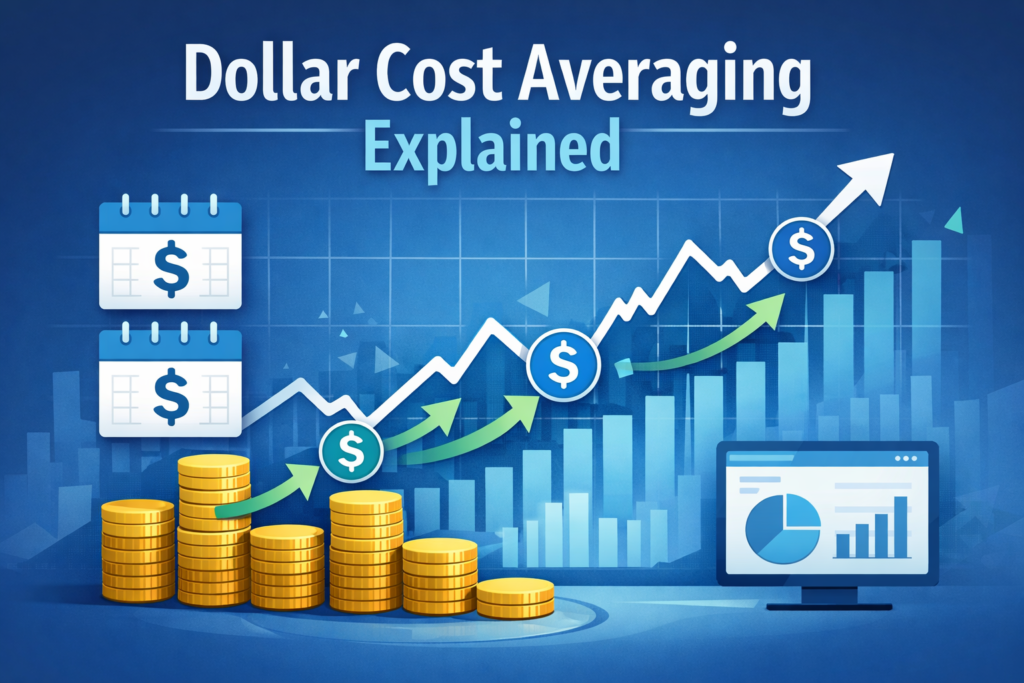
Dollar cost averaging offers a simple solution to this problem, instead of trying to predict the perfect time to invest, this strategy focuses on consistency. Investors contribute a fixed amount of money at regular intervals, allowing them to buy more shares when prices are low and fewer when prices are high.
Over time, this steady approach helps smooth out market fluctuations and removes much of the emotional pressure that often leads to poor investment decisions. In this guide, you will learn exactly how dollar cost averaging works, see practical examples, understand its advantages and limitations, and discover when it may be the right strategy for you.
What Is Dollar Cost Averaging?
Dollar cost averaging (often abbreviated as DCA) is an investment strategy where a person invests a fixed amount of money at regular intervals regardless of the asset’s price.
These intervals could be:
Weekly
Bi-weekly
Monthly
Quarterly
Because the amount invested stays constant, the number of shares purchased changes depending on the price, when prices are high, the fixed investment buys fewer shares, when prices are low, the same investment buys more shares.
Over time, this results in an average purchase price that smooths out market volatility.
Why Investors Use Dollar Cost Averaging
One of the biggest mistakes investors make is trying to time the market.
Market timing involves attempting to buy investments when prices are lowest and sell when prices are highest. While it sounds appealing, even professional investors struggle to consistently predict market movements. Dollar cost averaging solves this problem by removing the need for timing, instead of waiting for the “perfect” opportunity, investors simply follow a consistent schedule.
The strategy works particularly well because:
Markets move unpredictably in the short term
Prices fluctuate daily
Long-term market trends historically move upward
By investing steadily, investors participate in market growth without worrying about short-term fluctuations.
How Dollar Cost Averaging Works
The mechanics of dollar cost averaging are simple, which is one reason the strategy is widely used by both beginner and experienced investors.
At its core, dollar cost averaging involves investing a fixed amount of money at regular intervals, regardless of what the market is doing at that moment.
Instead of trying to guess whether prices will rise or fall tomorrow, next week, or next month, investors focus on maintaining a consistent investment schedule.
To implement this strategy, an investor typically decides three things:
1. The investment asset
This could be individual stocks, exchange-traded funds (ETFs), or diversified index funds that track major market indexes.
2. The fixed investment amount
This is the specific amount of money that will be invested each time. For example, an investor might commit to investing $200, $500, or $1,000 at each interval.
3. The investment schedule
The investor determines how often contributions will occur. This might be weekly, biweekly, monthly, or quarterly depending on income and financial goals.
Once these decisions are made, the process becomes automatic and predictable. The investor contributes the same amount at each scheduled interval, and the number of shares purchased changes depending on the market price at that time.
When prices are higher, the fixed amount buys fewer shares. When prices are lower, the same amount buys more shares.
Over time, these regular contributions accumulate into an investment portfolio while smoothing out the impact of market volatility.
To better understand how this works in practice, let’s look at a simple example.
Example 1: Monthly Investment in an Index Fund
Imagine an investor named Sarah who wants to build long-term wealth through the stock market. Rather than trying to predict the perfect time to invest, she decides to follow a dollar cost averaging strategy.
Sarah commits to investing $500 every month into an index fund. Over the next six months, the price of the fund fluctuates due to normal market movements.
| Month | Price per Share | Amount Invested | Shares Purchased |
|---|---|---|---|
| January | $50 | $500 | 10 shares |
| February | $40 | $500 | 12.5 shares |
| March | $25 | $500 | 20 shares |
| April | $40 | $500 | 12.5 shares |
| May | $50 | $500 | 10 shares |
| June | $60 | $500 | 8.33 shares |
At the end of six months:
Total invested: $3,000
Total shares purchased: 73.33 shares
To calculate Sarah’s average cost per share, divide the total amount invested by the total number of shares purchased.
$3,000 ÷ 73.33 ≈ $40.91 per share
This result reveals something interesting, even though the price of the fund eventually rose to $60 per share in June, Sarah’s average purchase price is only $40.91.
This happened because she bought more shares when prices were low and fewer shares when prices were high.
During March, when the market dipped and shares cost only $25, Sarah’s $500 bought 20 shares. That single month significantly reduced her overall average purchase price. This illustrates the core advantage of dollar cost averaging, market volatility can actually work in the investor’s favor.
Example 2: Investing a Lump Sum vs Dollar Cost Averaging
To better understand the strategy, it helps to compare it with a different approach known as lump sum investing.
Lump sum investing means putting all available money into the market at once rather than spreading investments over time. Imagine another investor named John who receives $6,000 and wants to invest in the same index fund Sarah used.
Scenario 1: Lump Sum Investment
John decides to invest the entire $6,000 immediately in January when the price is $50 per share.
Shares purchased:
$6,000 ÷ $50 = 120 shares
This means John owns 120 shares from the start, if the market rises steadily after his purchase, John may benefit significantly because his entire investment is already in the market.
Scenario 2: Dollar Cost Averaging
Instead of investing everything at once, John decides to invest $1,000 per month for six months, following a dollar cost averaging strategy.
Using the same price changes as before:
| Month | Price | Amount Invested | Shares Purchased |
|---|---|---|---|
| January | $50 | $1,000 | 20 |
| February | $40 | $1,000 | 25 |
| March | $25 | $1,000 | 40 |
| April | $40 | $1,000 | 25 |
| May | $50 | $1,000 | 20 |
| June | $60 | $1,000 | 16.67 |
At the end of six months:
Total invested: $6,000
Total shares purchased: 146.67 shares
Average purchase price:
$6,000 ÷ 146.67 = $40.91 per share
Because prices dropped significantly during the investment period, dollar cost averaging allowed John to accumulate more shares than if he had invested everything at once at $50 per share.
However, it is important to understand the trade-off.
If prices had risen consistently instead of falling, the lump sum strategy might have produced better results because the full investment would have been exposed to the rising market earlier.
This highlights an important truth about dollar cost averaging:
The strategy reduces timing risk, but it does not guarantee higher returns. Its main benefit is risk management and consistency, not necessarily maximizing short-term gains.
Real-World Example: Retirement Contributions
In reality, millions of people already practice dollar cost averaging without realizing it, one of the most common examples is retirement accounts, particularly employer-sponsored plans such as 401(k) accounts.
In these plans, employees contribute a portion of each paycheck into investment funds automatically.
For example, an employee might contribute 5% to 10% of their salary every pay period, because these contributions occur consistently regardless of market conditions, the employee purchases shares at different prices over time.
When markets decline, their contributions buy more shares, when markets rise, their contributions buy fewer shares.
Over years or decades, this steady accumulation builds a large portfolio through both consistent investing and compound growth.
This automatic dollar cost averaging is one of the reasons retirement accounts have historically been powerful long-term wealth-building tools.
Advantages of Dollar Cost Averaging
Dollar cost averaging offers several practical advantages that make it attractive to investors, especially those who prefer a simple and disciplined strategy.
1. Reduces Emotional Investing
Financial markets can trigger strong emotional reactions.
When prices drop suddenly, investors often panic and sell their investments out of fear. When markets surge, investors sometimes rush in and buy at inflated prices. These emotional decisions frequently lead to poor outcomes.
Dollar cost averaging removes much of this emotional pressure because investments follow a predetermined schedule. Instead of reacting to daily market news, investors simply continue contributing regularly. Consistency replaces impulse.
2. Reduces Market Timing Risk
Predicting market movements is extremely difficult, even for professional investors.
Short-term market behavior is influenced by countless factors including economic data, interest rates, geopolitical events, corporate earnings, and investor sentiment. Trying to perfectly time when to buy or sell is nearly impossible.
Dollar cost averaging spreads investments across multiple time periods, which reduces the risk of investing a large amount right before a market decline. By spreading purchases across months or years, investors naturally average out price fluctuations.
3. Encourages Investment Discipline
One of the most valuable habits in personal finance is consistent investing. Dollar cost averaging encourages investors to develop a routine of regularly contributing money to their portfolios.
This habit reinforces the principle of paying yourself first, meaning a portion of income is directed toward investments before it is spent elsewhere.
Over time, this disciplined approach can significantly increase wealth accumulation.
4. Makes Investing Accessible
Many people delay investing because they believe they need a large amount of money to get started. Dollar cost averaging proves that this belief is incorrect.
Investors can begin with relatively small amounts and still benefit from long-term market growth. For example, investing $50, $100, or $200 each month can gradually build a portfolio over time.
Combined with compound growth, even modest contributions can grow substantially over decades.
5. Works Well With Volatile Markets
Market volatility often scares investors, but for those using dollar cost averaging, volatility can actually be beneficial.
When markets decline, the fixed investment amount buys more shares at lower prices. These lower-cost shares can significantly improve long-term returns if markets recover later.
In other words, market downturns create opportunities for disciplined investors to accumulate more assets at discounted prices. Over time, this process can lower the average cost per share and strengthen overall portfolio growth.
Limitations of Dollar Cost Averaging
Dollar cost averaging is a powerful and widely used investment strategy, but it is not perfect, like any financial approach, it comes with trade-offs that investors should understand before relying on it.
Knowing these limitations helps investors apply the strategy more effectively and choose the right approach for their situation.
1. Lump Sum Investing Often Performs Better in Rising Markets
Over long periods, stock markets have historically trended upward. Because of this general upward movement, investing money immediately can sometimes produce higher returns than spreading investments over time.
When an investor uses dollar cost averaging, part of the money remains uninvested while waiting for future contribution dates. If the market rises steadily during this time, those delayed investments miss potential gains.
For example, imagine investing $10,000 when the market is steadily increasing. If the full amount is invested immediately, it benefits from every increase in price. However, if the same $10,000 is spread over ten months using dollar cost averaging, only a portion of the money participates in those early gains.
Because of this, lump sum investing has historically outperformed dollar cost averaging in many rising market scenarios.
2. The Strategy Requires Consistency
Dollar cost averaging works best when investors follow the plan consistently.
Skipping contributions, delaying investments, or abandoning the strategy during market downturns can reduce its effectiveness. The true strength of DCA lies in its regular and disciplined approach.
For example, if an investor stops contributing during a market decline out of fear, they may miss the opportunity to buy shares at lower prices. Ironically, market downturns are often when dollar cost averaging provides the greatest advantage.
Consistency is what allows the strategy to smooth out price fluctuations over time.
3. Transaction Costs Can Add Up
In the past, frequent investing meant paying brokerage fees every time shares were purchased. For investors making monthly or weekly contributions, these fees could significantly reduce returns.
Today, many brokerage platforms offer commission-free trading, which has made dollar cost averaging far more practical and cost-effective.
However, investors should still be aware of other potential costs, such as:
Fund management fees
Account maintenance fees
Currency conversion costs for international investments
Even small expenses can impact long-term returns when investments are held for many years.
4. Slower Market Exposure
Another limitation of dollar cost averaging is that money enters the market gradually.
While this reduces the risk of investing everything at the wrong time, it also means the full investment is not working in the market immediately.
If markets rise quickly after an investor begins a DCA strategy, the investor may miss out on part of that growth because some funds have not yet been invested.
In essence, dollar cost averaging trades potentially higher returns for lower timing risk. For many investors, this trade-off is worthwhile because it provides psychological comfort and reduces the fear of investing at the wrong moment.
When Dollar Cost Averaging Works Best
Dollar cost averaging can be particularly effective in certain situations. It is most beneficial for investors who want a structured and disciplined approach to building wealth over time.
1. Beginners Learning to Invest
For people new to investing, market volatility can feel overwhelming. Prices fluctuate daily, financial news can be confusing, and the fear of making a costly mistake often prevents beginners from getting started.
Dollar cost averaging provides a simple solution. By investing a fixed amount on a regular schedule, beginners can enter the market gradually without worrying about choosing the perfect time to invest.
This approach allows new investors to gain confidence while building experience over time.
2. Regular Income Earners
People who earn a steady paycheck are naturally well suited to the dollar cost averaging strategy.
Each month, a portion of income can be directed toward investments before being spent elsewhere. This creates a consistent investment habit that gradually builds a portfolio.
Many investors automate this process by setting up recurring transfers to their investment accounts. Automation removes the temptation to delay or skip contributions.
Over years or decades, these regular investments can grow substantially through compounding.
3. Volatile Market Conditions
Financial markets occasionally experience periods of heightened volatility. Prices may swing dramatically due to economic uncertainty, geopolitical events, or changes in interest rates. During these periods, trying to predict short-term market movements becomes extremely difficult.
Dollar cost averaging helps reduce this uncertainty by spreading investments across time. Instead of committing a large amount during a potentially unstable period, investors gradually enter the market as prices fluctuate. This approach can help reduce the risk of investing a large sum right before a sudden market drop.
4. Long-Term Investment Goals
Dollar cost averaging is most effective when used for long-term financial goals.
Examples include:
Retirement savings
Building long-term wealth
Saving for children’s education
Achieving financial independence
These goals typically span many years or decades. Over such long time horizons, the impact of short-term market fluctuations becomes less important. Regular contributions combined with compound growth allow investors to steadily accumulate assets over time.
When Lump Sum Investing May Be Better
Although dollar cost averaging is popular, lump sum investing may be the better choice in certain situations.
Lump sum investing involves placing the entire investment into the market at once rather than spreading it across multiple periods.
This approach may be advantageous in cases such as:
Receiving a large inheritance or financial windfall
Selling a property or business and reinvesting the proceeds
Entering the market after a significant downturn
Having a long investment horizon that reduces short-term risk concerns
Because markets tend to rise more often than they fall, investing money sooner often leads to stronger long-term performance.
Several studies from major investment firms have shown that lump sum investing historically outperforms dollar cost averaging approximately two-thirds of the time.
However, this does not mean it is always the better choice for every investor. Psychology plays an important role in investing. If spreading investments over time helps an investor feel more comfortable and remain committed during market volatility, dollar cost averaging may ultimately lead to better long-term behavior.
In many cases, the best strategy is the one an investor can follow consistently.
Dollar Cost Averaging With Different Investments
Dollar cost averaging is a flexible strategy that can be applied to a wide variety of asset types. Investors can use it with both traditional financial instruments and newer investment options.
1. Stocks
Investors can apply dollar cost averaging to individual company stocks by purchasing shares on a regular schedule. While this approach can work, it carries higher risk because a single company’s performance can fluctuate dramatically due to business conditions, competition, or economic changes.
For this reason, many investors prefer more diversified investment options.
2. Index Funds
Index funds are among the most popular choices for dollar cost averaging.
These funds track the performance of a broad market index and contain many companies within a single investment. For example, an index fund might track hundreds or even thousands of companies across different industries. This diversification reduces the risk associated with any single company performing poorly.
Because index funds are typically low-cost and widely diversified, they are often recommended for long-term investors using dollar cost averaging.
3. Exchange-Traded Funds (ETFs)
Exchange-traded funds, commonly known as ETFs, operate similarly to index funds but trade on stock exchanges like individual stocks.
This means investors can buy and sell ETF shares throughout the trading day. ETFs are widely used for dollar cost averaging because they often offer:
Low management fees
Broad diversification
Easy accessibility through most brokerage accounts
Many investors build entire portfolios using a small number of diversified ETFs.
4. Cryptocurrency
Some investors also apply dollar cost averaging to digital assets such as cryptocurrency. Cryptocurrency markets are known for extreme price volatility, with prices sometimes rising or falling dramatically within short periods.
Because of this unpredictability, investing a large amount at once can be risky. Dollar cost averaging allows investors to spread purchases across time, reducing the chance of buying at a temporary price peak.
However, cryptocurrency remains a highly speculative asset class, so investors should approach it cautiously and only invest amounts they can afford to lose.
Building a Dollar Cost Averaging Plan
Creating a DCA strategy involves a few simple steps.
Step 1: Define Your Goal
Determine why you are investing.
Examples include:
Retirement savings
Building long-term wealth
Saving for a house
Clear goals help guide investment decisions.
Step 2: Choose Investments
Select diversified assets suitable for long-term growth.
Many investors prefer:
Broad market index funds
Global ETFs
Balanced portfolios
Step 3: Decide Contribution Amount
Choose an amount that fits comfortably within your budget.
Consistency matters more than size.
Step 4: Automate Investments
Automation ensures contributions occur regardless of market emotions. Most brokerage platforms allow automatic recurring investments.
Step 5: Stay Consistent
The most important rule is simple:
Continue investing through both good and bad market periods. Volatility is part of investing, consistency turns that volatility into opportunity.
Dollar Cost Averaging and Compounding
Dollar cost averaging becomes powerful when combined with compound growth.
Compounding occurs when investment returns generate additional returns over time.
For example: If you invest $500 monthly and earn an average return of 8 percent annually, after 30 years you would have invested $180,000.
However, the portfolio value could grow to over $700,000 due to compounding. This demonstrates why consistency matters more than attempting to time the market perfectly.
Psychological Benefits of Dollar Cost Averaging
Investing is not purely mathematical, psychology plays a huge role.
Many investors abandon their strategies during market downturns because fear overwhelms logic.Dollar cost averaging helps counter this behavior by creating a routine.
Instead of worrying about daily price movements, investors focus on long-term contributions. This mindset encourages patience, which is one of the most valuable traits in investing.
Common Mistakes to Avoid
Even simple strategies can fail if used incorrectly. Here are some mistakes investors should avoid.
1. Trying to Time DCA Purchases
Some investors attempt to delay scheduled investments when markets appear high.
This defeats the purpose of the strategy. DCA works best when investments occur consistently regardless of market conditions.
2. Stopping During Market Crashes
Market downturns are exactly when DCA becomes most valuable.
Lower prices allow investors to accumulate more shares.
Stopping contributions during crashes prevents investors from benefiting from discounted prices.
3. Investing Without Diversification
Putting all contributions into a single stock increases risk dramatically. Diversified funds are usually more appropriate for long-term DCA strategies.
4. Ignoring Investment Costs
High management fees or transaction costs can reduce long-term returns.
Low-cost funds and commission-free platforms help maximize results.
Key Takeaways
Dollar cost averaging is one of the simplest and most effective strategies for long-term investing. Its power lies in consistency rather than complexity.
The approach involves investing a fixed amount at regular intervals regardless of market conditions, this strategy helps reduce emotional decision-making, lowers the risk of poor market timing, and encourages disciplined investing habits.
While lump sum investing may sometimes produce higher returns, dollar cost averaging offers psychological comfort and stability that many investors need to stay committed.
Over time, steady contributions combined with compound growth can transform small investments into substantial wealth.
Final Thoughts
Building wealth through investing does not require predicting market highs or mastering complex financial strategies. In reality, many successful investors rely on simple principles that emphasize patience, consistency, and long-term thinking.
Dollar cost averaging reflects these principles perfectly. Instead of worrying about short-term market movements, investors focus on investing regularly and allowing time to work in their favor. By contributing a fixed amount at consistent intervals, investors naturally buy more shares when prices are low and fewer when prices are high. Over time, this approach smooths out market volatility and reduces the pressure of trying to make perfect investment decisions.
Just as importantly, dollar cost averaging helps develop strong financial habits. Regular investing encourages discipline, removes emotional decision-making, and builds a long-term mindset that is essential for sustainable wealth creation.
Of course, no strategy guarantees profits, and markets will always experience periods of uncertainty. Prices will rise, fall, and sometimes move unpredictably. However, investors who remain consistent during both market highs and downturns position themselves to benefit from long-term market growth. The key lesson is simple, starting early and staying committed often matters more than timing the market perfectly.
Over years and decades, small but consistent investments can grow into significant wealth through the combined power of market growth and compounding.
For investors who want a straightforward, disciplined, and beginner-friendly strategy, dollar cost averaging remains one of the most reliable ways to begin the journey toward long-term financial success.
Related Blog Post:
- Index Funds Explained: 9 Powerful Reasons They Beat Most Investors
- 7 Smart Ways to Start Investing With $100 or Less Today
- Stocks vs Bonds vs ETFs: 7 Powerful Differences Every Beginner Must Understand
- How Investing Works for Complete Beginners: 9 Powerful Steps to Start Building Wealth
- Beginner’s Guide to Investing Money Safely: 10 Smart Strategies for New Investors
- Net Worth Explained: 7 Simple Steps to Calculate Yours Today
- 10 Smart Ways to Track Expenses Without Feeling Restricted and Still Enjoy Life