Index Funds Explained: 9 Powerful Reasons They Beat Most Investors
Many people believe successful investing requires predicting the market, discovering the next hot stock, or constantly monitoring financial news. Social media is filled with trading tips, bold predictions, and stories of investors who supposedly beat the market. For someone just starting out, all of that noise can make investing feel confusing and intimidating.
But what if building wealth did not require any of that? What if one of the most effective investment strategies was also one of the simplest?
For decades, a quiet approach has consistently outperformed most professional investors, hedge funds, and active traders, it does not rely on guessing which stock will skyrocket next. It does not require constant research or complicated strategies, instead it focuses on owning the market itself. That strategy is investing in index funds.
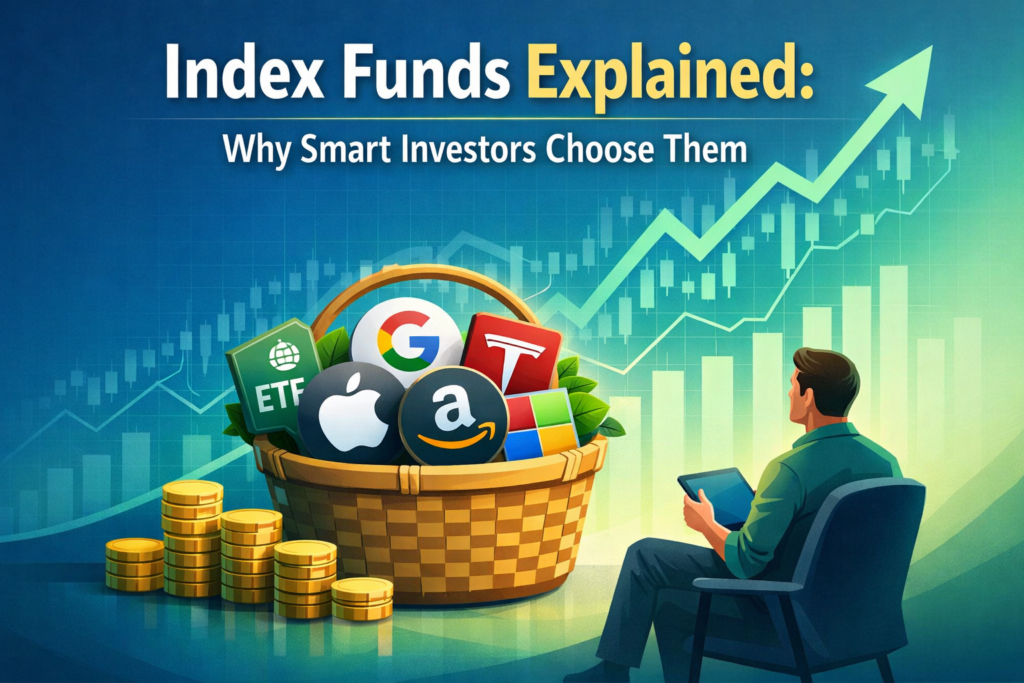
Index funds allow investors to buy a broad slice of the entire market in a single investment. They are simple, low cost, diversified, and historically powerful tools for long term wealth building.
In this guide, you will learn exactly what index funds are, how they work, and why this straightforward strategy often beats the complex approaches used by many experienced investors. Once you understand the logic behind index investing, you may realize that successful investing is far simpler than it first appears.
What Are Index Funds?
Index funds are investment funds built to replicate the performance of a specific market index. Instead of relying on a fund manager to choose which stocks might perform best, an index fund simply follows a predefined list of companies that already make up a major market index.
Think of an index as a snapshot of a portion of the stock market. It represents a group of companies selected according to specific rules, such as size, industry, or geographic location. When the companies in that index grow in value, the index rises. When they decline, the index falls.
An index fund works by purchasing the same companies included in that index, usually in the same proportions. As a result, the fund’s performance closely tracks the performance of the index itself.
This approach eliminates the need to guess which individual stocks will outperform. Instead, the investor gains exposure to the overall performance of a large portion of the market.
For example, if you invest in a fund that tracks the S&P 500, you are effectively investing in 500 of the largest publicly traded companies in the United States through a single investment.
Examples of Popular Market Indices
Different indices represent different parts of the global economy. Some focus on large companies in a specific country, while others track international markets.
Some widely followed indices include:
1. S&P 500
Tracks 500 of the largest publicly traded companies in the United States across industries such as technology, healthcare, finance, and consumer goods.
2. Dow Jones Industrial Average
Tracks 30 major U.S. companies considered leaders in their industries.
3. NASDAQ-100
Focuses on 100 of the largest non-financial companies listed on the Nasdaq exchange, with strong representation from technology companies.
4. FTSE 100
Tracks the 100 largest companies listed on the London Stock Exchange and is often used as a benchmark for the UK stock market.
5. MSCI World Index
Tracks large and mid-cap companies across more than 20 developed countries, providing exposure to global markets.
By investing in funds that track these indices, investors gain instant diversification across many companies and industries, significantly reducing the risk associated with investing in a single stock.
How Index Funds Work
Index funds follow a passive investment strategy. Instead of actively researching companies and making frequent trading decisions, the fund simply mirrors the structure of the index it tracks.
When the index changes, the fund adjusts its holdings to stay aligned with it. For example, if a company is added to the S&P 500, an S&P 500 index fund will purchase shares of that company. If a company is removed from the index, the fund sells its shares.
Because this process follows predetermined rules rather than human judgment, index funds require far less management than traditional actively managed funds.
There are two common structures used to deliver index fund investments.
1. Mutual Funds
Index mutual funds pool money from many investors and use it to purchase the stocks or bonds included in the chosen index. Investors buy shares of the fund, and the value of those shares reflects the value of the underlying assets held in the portfolio.
Mutual funds are priced once per trading day, after the market closes. This price is known as the net asset value (NAV). All buy and sell orders placed during the day are executed at that single price.
Many retirement accounts and long-term investment plans use mutual funds because they allow automatic contributions and reinvestment of dividends.
2. ETFs (Exchange-Traded Funds)
Index funds can also exist as exchange-traded funds, commonly called ETFs.
ETFs track indices in the same way as mutual funds, but they trade on stock exchanges just like individual stocks. This means investors can buy and sell ETF shares throughout the trading day at market prices. ETFs often provide greater flexibility and typically have lower minimum investment requirements. For many investors, they are one of the easiest ways to access index investing.
Core Principles Behind Index Funds
Index investing is built on several simple but powerful principles that explain why it has become one of the most widely recommended strategies for long-term investors.
1. Passive Management
Traditional actively managed funds rely on portfolio managers who research companies and attempt to outperform the market through frequent buying and selling.
Index funds take the opposite approach. Instead of trying to beat the market, they aim to match the market’s performance by tracking a specific index.
Because the investment decisions are rule-based rather than opinion-based, trading activity is minimal and management costs remain low.
2. Diversification
Diversification means spreading investments across many assets to reduce risk.
When you buy shares of an index fund, you gain exposure to all the companies included in that index. Depending on the fund, that could mean dozens, hundreds, or even thousands of companies.
This diversification reduces the impact of poor performance from any single company. Even if one business struggles, the overall portfolio remains supported by many others.
3. Low Costs
One of the most important advantages of index funds is their low expense ratios.
Actively managed funds require teams of analysts, frequent trading, and extensive research, all of which increase operating costs. These costs are passed on to investors in the form of higher fees. Index funds, by contrast, operate with far less overhead. Since they simply follow an index, management costs are significantly lower. Over time, these savings can make a substantial difference in long-term investment returns.
Why Index Funds Beat Most Investors
Many investors attempt to outperform the market by selecting individual stocks, timing market movements, or chasing short-term opportunities. While some succeed for brief periods, very few maintain that success consistently over long time horizons.
Research over several decades shows that most professional fund managers fail to outperform their benchmark indices after accounting for fees.
Index funds outperform many investors for several practical reasons.
1. They Reduce Emotional Decision-Making
Financial markets are heavily influenced by human psychology.
When markets rise rapidly, investors often feel pressure to buy more assets out of fear of missing out. When markets fall, fear leads many investors to sell at the worst possible moment.
These emotional reactions frequently result in buying high and selling low. Index investing helps reduce this behavior because the strategy focuses on long-term market participation rather than short-term predictions. Investors simply continue contributing regularly without reacting to daily market fluctuations.
2. Low Fees Preserve More Returns
Fees may seem small at first glance, but they compound over time just like investment gains.
For example, an actively managed fund charging 2 percent annually may not appear expensive. However, over several decades that fee significantly reduces the amount of money left in the portfolio.
Index funds typically charge a fraction of those costs, often between 0.03 percent and 0.25 percent annually. Lower costs allow a greater portion of investment returns to remain invested and continue compounding.
3. Diversification Limits Company-Specific Risk
Investors who concentrate their money in a small number of stocks face significant risk. A single disappointing earnings report, leadership scandal, or industry disruption can cause dramatic losses.
Index funds spread investments across many companies, industries, and sometimes countries. This diversification reduces the impact of any single company’s performance on the overall portfolio.
4. They Capture Overall Market Growth
While individual companies rise and fall, the broader stock market has historically grown over long periods as economies expand, technology advances, and businesses increase productivity.
By tracking major indices such as the S&P 500, index funds allow investors to participate in that long-term growth rather than trying to predict which companies will succeed.
Historically, the S&P 500 has produced average long-term annual returns of roughly 10 percent including dividends, although returns vary from year to year.
5. They Eliminate the Need to Time the Market
Market timing involves attempting to buy investments before prices rise and sell them before prices fall. Even experienced investors struggle to do this consistently.
Missing just a few of the market’s best days can significantly reduce long-term returns. Index investing avoids this problem by encouraging consistent investing over time, often through strategies such as dollar-cost averaging, where investors contribute fixed amounts at regular intervals regardless of market conditions.
Types of Index Funds
Index funds exist for many different parts of the financial markets. Investors can choose funds based on their goals, time horizon, and risk tolerance.
1. Stock Index Funds
Stock index funds track groups of publicly traded companies. Funds that follow indices such as the S&P 500, FTSE 100, or MSCI World Index allow investors to gain exposure to broad segments of the global stock market.
These funds are typically used for long-term growth because stocks historically generate higher returns than most other asset classes over extended periods.
2. Bond Index Funds
Bond index funds track collections of government or corporate bonds.
Because bonds generally experience less volatility than stocks, these funds are often used to provide stability and income within a diversified portfolio. They may also help reduce overall portfolio risk during periods of stock market decline.
3. Sector or Thematic Index Funds
Some index funds focus on specific industries or themes. Examples include funds tracking technology companies, healthcare firms, renewable energy businesses, or financial institutions. These funds allow investors to target particular sectors they believe will grow faster than the overall market.
However, because they are less diversified, sector funds typically carry higher risk than broad market funds.
4. International Index Funds
International index funds track companies outside an investor’s home country.
These funds may focus on developed markets, emerging markets, or global indices that combine companies from many regions. Including international exposure in a portfolio can reduce reliance on the economic performance of a single country while allowing investors to participate in growth across the global economy.
How to Choose the Right Index Fund
Not all index funds are the same, while they share the same basic strategy of tracking a market index, they differ in the assets they hold, their costs, and how they fit into an investor’s overall strategy.
Choosing the right index fund involves understanding your financial goals and evaluating a few key factors.
1. Understand Your Investment Goals
Your investment objective should guide your fund selection. If you are investing for long-term goals such as retirement, stock index funds that track broad markets often make sense because they historically provide higher long-term growth.
If your timeline is shorter or you prefer less volatility, adding bond index funds or balanced funds may be more appropriate. Your time horizon also influences risk tolerance. Investors with decades before retirement can typically handle more market fluctuations than those who may need their money sooner.
2. Pay Close Attention to Fees
Costs may seem small, but they have a powerful impact on long-term results.
Every index fund charges an expense ratio, which is the annual fee taken as a percentage of your investment. Even a difference of 0.5 percent can significantly reduce long-term returns.
Low-cost providers such as Vanguard, Fidelity Investments, and Charles Schwab are widely known for offering inexpensive index funds.
When comparing funds that track the same index, choosing the one with the lowest expense ratio is usually the better option.
3. Understand What the Fund Tracks
Every index fund follows a specific index, and that index determines what companies the fund will hold.
For example, funds tracking the S&P 500 focus on large, established U.S. companies such as technology, healthcare, and financial firms.
Funds tracking the Russell 2000, on the other hand, invest in smaller companies that often have higher growth potential but also greater volatility.
Before investing, it is important to understand which part of the market the index represents and whether that exposure fits your strategy.
4. Consider Fund Size and Liquidity
The size of a fund, often measured by assets under management, can affect its stability and trading efficiency.
Larger funds generally have:
Higher liquidity
Narrower trading spreads for ETFs
Lower operational risk
For ETF investors, liquidity is especially important because it ensures you can buy or sell shares quickly without significant price differences.
5. Evaluate Tax Efficiency
Taxes can affect investment returns, particularly in taxable accounts.
Many index funds are already tax-efficient because they trade less frequently than actively managed funds. However, ETFs often have an additional tax advantage, as their structure can reduce capital gains distributions.
For long-term investors, tax efficiency can help preserve more of the portfolio’s growth.
How to Invest in Index Funds
One of the biggest advantages of index investing is how simple it is to get started. Even beginners with small amounts of money can begin building a diversified portfolio.
Step 1: Open a Brokerage Account
The first step is opening an investment account with a reputable brokerage.
Major global platforms provide access to index funds and ETFs, including:
Vanguard
Fidelity Investments
Charles Schwab
Interactive Brokers
Most platforms allow investors to open accounts online within minutes.
Step 2: Decide How Much to Invest
You do not need a large amount of money to begin investing. Thanks to compound growth, even small contributions can grow substantially over time. For example, investing $100 per month consistently for several decades can build a significant portfolio.
The most important factor is consistency, not the initial amount.
Step 3: Choose Your Funds
Beginners often start with broad market index funds because they provide diversification across many companies.
Examples include funds tracking:
S&P 500
MSCI World Index
Total stock market indices
To create a more balanced portfolio, investors may also add:
International index funds
Bond index funds
This combination spreads risk across multiple markets and asset classes.
Step 4: Set Up Automatic Contributions
Automation is one of the most effective ways to stay disciplined.
Many brokerages allow investors to schedule automatic monthly contributions into selected funds. This strategy ensures regular investing regardless of market conditions and removes the temptation to delay investing while waiting for the “perfect” moment.
Step 5: Monitor and Rebalance
Index investing requires far less maintenance than active trading, but occasional review is still important.
Checking your portfolio once or twice per year helps ensure it still matches your intended asset allocation. If certain investments grow faster than others, rebalancing may be necessary to maintain your preferred mix of stocks, bonds, and international exposure.
Common Misconceptions About Index Funds
Despite their popularity, several misconceptions about index funds still exist.
Myth 1: You Cannot Beat the Market With Index Funds
Index funds are not designed to outperform the market. Their goal is to match the performance of the index they track.
However, this strategy often ends up outperforming many investors because most actively managed funds fail to beat their benchmark over long periods, especially after fees.
Myth 2: Index Funds Are Only for Beginners
While index funds are simple enough for beginners, they are also widely used by experienced investors, financial advisors, and large institutions.
Many professional portfolios rely heavily on index funds to achieve broad market exposure at low cost.
Myth 3: Index Funds Do Not Pay Dividends
Many of the companies included in major indices pay dividends to shareholders.
Index funds collect these dividends from the underlying companies and distribute them to investors. These payments can either be received as income or reinvested to accelerate long-term growth.
Myth 4: Investors Do Not Own the Stocks
When you invest in an index fund, the fund purchases the underlying stocks on behalf of all shareholders.
Although the fund holds the shares collectively, investors still benefit from the capital gains and dividends generated by those companies.
Real-Life Examples of Index Fund Success
The success of index investing can be seen through some of the largest and most widely held funds in the world.
One well-known example is the Vanguard 500 Index Fund (VFIAX), which tracks the S&P 500. Since its launch in 1976, it has provided investors with consistent exposure to the growth of major U.S. companies.
Another widely traded fund is the SPDR S&P 500 ETF (SPY), one of the largest ETFs in the world. It allows investors to gain instant exposure to the S&P 500 through a single ETF share.
These funds demonstrate the long-term impact of broad diversification and disciplined investing.
Risks and Considerations
Although index funds are generally considered safer than concentrated stock picking, they are not completely risk-free.
1. Market Risk
Because index funds track entire markets, their value rises and falls with overall market conditions. During economic downturns or financial crises, index funds can decline significantly in the short term. Investors must be prepared to tolerate volatility while focusing on long-term goals.
2. Inflation Risk
If inflation rises faster than investment returns, the purchasing power of money can decline.
Diversifying into assets such as stocks, international investments, or real assets can help reduce this risk over long periods.
3. Overconcentration Risk
Investing heavily in a single index may concentrate your exposure in one region or type of company.
For example, the S&P 500 focuses on large U.S. companies. While these companies are influential globally, relying solely on one index may leave a portfolio less diversified than intended.
Including global or international funds can help balance that exposure.
Tips for Maximizing Index Fund Returns
Investors who follow a few simple principles can significantly improve their long-term results.
1. Invest early and consistently.
The longer your money stays invested, the more time compounding has to work.
2. Reinvest dividends.
Reinvested dividends purchase additional shares, accelerating long-term growth.
3. Keep costs low.
Small fee differences compound into large differences in portfolio value over time.
4. Stay disciplined during market volatility.
Market declines are normal. Selling during downturns often locks in losses.
5. Diversify across assets and regions.
Combining stock, bond, and international funds can help stabilize long-term performance.
Why Index Funds Are Ideal for Modern Investors
Index funds have grown enormously in popularity over the past few decades because they solve many of the challenges faced by individual investors.
1. Simplicity
They eliminate the need for complex stock research or constant market monitoring.
2. Cost efficiency
Low expense ratios allow investors to keep more of their investment returns.
3. Proven long-term performance
Decades of historical data show that broad market indices have generated strong returns over time.
4. Accessibility
With modern brokerage platforms, anyone can begin investing with small amounts and gradually build a diversified portfolio.
For many investors, index funds represent a practical balance between growth, diversification, and simplicity, making them one of the most effective tools available for long-term wealth building.
Conclusion: Start with Index Funds Today
Investing success rarely comes from complicated strategies or constant trading. In reality, the most effective approach for many investors is also the simplest: owning a broad portion of the market and allowing time and compounding to work.
Index funds make that possible by tracking major indices such as the S&P 500 or the MSCI World Index, they provide instant diversification across hundreds of companies with minimal cost and effort.
This structure removes many of the challenges that cause investors to struggle, you do not need to predict market movements, identify the next winning stock, or react to every piece of financial news. Instead, the strategy focuses on consistency, patience, and broad exposure to economic growth.
Over time, the combination of low fees, diversified holdings, and disciplined investing can produce powerful long-term results.
Key Takeaways
Index funds track a market index, giving investors exposure to many companies through a single investment.
Their passive structure keeps fees low, which helps preserve long-term returns.
Diversification reduces the risk associated with individual stocks.
Consistent investing and reinvesting dividends accelerate compound growth.
Long-term discipline matters more than short-term market timing.
Building wealth through investing does not require extraordinary skill. What matters most is starting early, staying invested, and following a strategy you can maintain over time.
For many investors around the world, index funds provide one of the clearest and most reliable paths toward that goal.
Related Blog Post:
- 21 Personal Finance Basics Every Adult Should Know for Financial Freedom
- 7 Smart Ways to Start Investing With $100 or Less Today
- Stocks vs Bonds vs ETFs: 7 Powerful Differences Every Beginner Must Understand
- How Investing Works for Complete Beginners: 9 Powerful Steps to Start Building Wealth
- Beginner’s Guide to Investing Money Safely: 10 Smart Strategies for New Investors
- Net Worth Explained: 7 Simple Steps to Calculate Yours Today
- 10 Smart Ways to Track Expenses Without Feeling Restricted and Still Enjoy Life