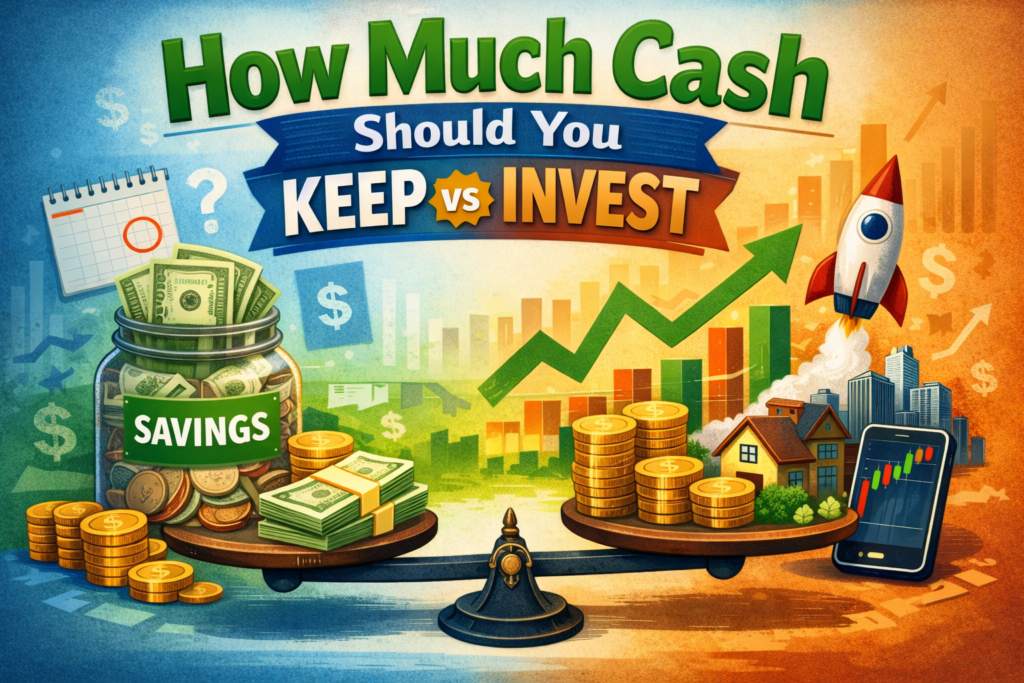
How Much Cash Should You Keep vs Invest: 7 Smart Strategies for Financial Security
Money decisions rarely fail because people do not earn enough, they fail because money is left idle in the wrong places.
Keeping too much cash feels safe, but it quietly loses value to inflation. Investing too aggressively feels smart, until an emergency forces you to sell at the worst possible time. Most people are stuck between these two mistakes without realizing it.
The real question is not whether to save or invest, it is how to divide your money so it protects your life today while still building wealth for tomorrow.
Getting this balance right depends on more than generic rules, it depends on your income stability, time horizon, financial goals, and tolerance for uncertainty. When those factors are ignored, even good financial habits can work against you.
This guide breaks down how much cash you actually need, when investing makes sense, and how to structure both so your money works without exposing you to unnecessary risk.
Understanding Cash vs Investments
Before deciding how much to keep in cash or invest, you need to understand what each one is designed to do in your financial life.
Cash and investments are not competing options, they are tools with completely different jobs.
Most financial mistakes happen when people ask cash to do the job of investments, or expect investments to behave like cash. Once you separate their roles clearly, the right balance becomes much easier to see.
Cash: Security and Liquidity
Cash is the foundation of financial stability. Its primary purpose is not growth. Its purpose is access and protection.
Cash is highly liquid, meaning you can use it immediately without penalties, delays, or market risk. It includes more than physical money, cash also covers funds held in checking accounts, savings accounts, and money market accounts.
When something unexpected happens, cash is what keeps your life running without forcing bad financial decisions.
Why Cash Matters
Cash plays a quiet but critical role in your finances:
It gives you immediate access to money during emergencies
It reduces stress and panic when things go wrong
It protects you from being forced to sell investments at the wrong time
This is why people with solid cash reserves often weather financial shocks better than those with higher net worth but poor liquidity.
The Cost of Holding Too Much Cash
While cash feels safe, it comes with hidden downsides when held in excess:
Cash usually earns little or no return
Inflation slowly reduces its purchasing power
Money sitting idle misses out on long-term growth opportunities
Over time, excessive cash holdings can quietly weaken your financial position. The danger is not obvious day to day, but it becomes clear over years.
Cash should protect your life. It should not be expected to build wealth.
Investments: Growth and Compounding
Investments exist for one reason, to grow your money over time.
When you invest, you accept short-term uncertainty in exchange for long-term returns. Unlike cash, investments are not designed for quick access, they are designed to compound.
Common investment options include:
Stocks and stock mutual funds
Bonds and bond funds
Real estate
ETFs
Retirement accounts such as 401(k), IRA, or RRSP
Investments fluctuate in value, some years they perform well, other years they do not. That volatility is not a flaw, it is the price of long-term growth.
Why Investing Is Necessary
Investing offers benefits that cash simply cannot provide:
Higher long-term returns compared to savings
Wealth creation over time
Compounding, where earnings generate more earnings
Without investing, it becomes extremely difficult to outpace inflation, build retirement security, or grow wealth beyond what you earn.
The Risks of Investing
Investments are powerful, but they are not risk-free:
Values can drop, sometimes sharply
Market volatility can trigger emotional decisions
Some investments are not easy to access quickly
This is why investing without a proper cash foundation often leads to panic selling and long-term damage.
Investments grow your future. They should not be relied on to protect your present.
How Much Cash Should You Keep?
Deciding how much cash to hold is about balance. You want enough to feel secure and flexible, but not so much that your money stops working for you. There are three main categories of cash you should plan for.
Emergency Fund: The Foundation
An emergency fund is non-negotiable. It is money reserved specifically for unexpected events such as medical expenses, car repairs, or temporary income loss.
General guidelines:
3 to 6 months of essential expenses for most people
6 to 12 months if your income is unstable or you support others
12 months or more if your situation is high risk
This money should be kept in safe, highly liquid accounts like high-yield savings or money market accounts. No penalties. No market risk.
Example:
If your monthly expenses are $3,000, a six-month emergency fund equals $18,000. This money is not for investing, upgrading your lifestyle, or chasing opportunities. It exists to protect you when life happens.
Cash for Short-Term Goals
Cash is also necessary for goals you plan to achieve within the next one to three years.
Common examples include:
A home down payment
Buying a car
Travel or major personal expenses
Money needed in the near future should not be exposed to market swings. A market downturn at the wrong time could leave you short when you need the funds.
For short-term goals, prioritize stability over returns. High-yield savings accounts, short-term CDs, or very low-risk instruments are appropriate.
Cash Cushion for Market Volatility
Some people choose to keep additional cash as a strategic reserve, this is often called an opportunity fund, its purpose is simple, flexibility.
This cash allows you to invest during market downturns without touching your emergency fund or selling existing investments. It is optional, not mandatory, but useful for disciplined investors.
The key rule is this: opportunity cash should never replace your emergency fund or short-term savings.
How Much Should You Invest?
Once your emergency fund and short-term goals are fully covered, the remaining money should be directed toward investments.
This is where long-term wealth is built, there is no universal percentage that works for everyone. The right amount depends on:
Your risk tolerance
Your time horizon
Your financial goals
Your income stability
The longer your timeline, the more investment risk you can usually afford to take.
Determine Your Investment Goals
Clear goals guide smart investing, without them, people either take too much risk or stay overly cautious.
Common investment goals include:
Retirement
This is typically the longest-term goal. It favors growth-oriented assets and tax-advantaged accounts.
Wealth Building
This includes growing capital through brokerage accounts, businesses, or real estate over many years.
Passive Income
This focuses on generating steady cash flow through dividends, rental income, or interest-bearing assets.
Each goal may require a different investment mix. Trying to use one strategy for everything often leads to frustration.
Risk Tolerance and Asset Allocation
Risk tolerance is your ability to endure fluctuations in the market without panic selling. Asset allocation, how you split investments across stocks, bonds, and other assets is a key factor.
A general guideline is:
Younger investors with high risk tolerance: 80-90% stocks, 10-20% bonds
Moderate risk: 60-70% stocks, 30-40% bonds
Low risk: 30-50% stocks, 50-70% bonds
As a rule of thumb, the more years until you need the money, the more you can afford to invest in higher-risk assets like stocks, because time smooths out volatility.
Long-Term Growth vs Cash
Investing isn’t just about earning returns; it’s about beating inflation. Cash loses value over time due to inflation, whereas investments tend to grow at rates higher than inflation over the long term. Even a conservative investment portfolio can yield 4-6% annualized returns, which compounds over time.
Factors That Affect Your Cash vs Investment Decision
Deciding how much to hold in cash versus invest is personal. Consider these factors:
1. Income Stability
If your income is unpredictable, keep more cash as a buffer.
If you have a stable salary and low debt, you can invest more aggressively.
2. Expenses and Lifestyle
High fixed expenses may require a larger cash reserve.
If your lifestyle is flexible, you may tolerate more investment risk.
3. Market Conditions
Economic downturns can make holding some cash appealing.
When interest rates rise, cash in high-yield accounts can earn meaningful returns.
4. Debt Obligations
High-interest debt should generally be paid off before investing heavily.
Low-interest debt, like some mortgages, can coexist with investing.
5. Age and Time Horizon
Younger investors can invest a larger percentage because they have decades to recover from downturns.
Older investors nearing retirement should prioritize cash and low-risk investments to preserve capital.
Common Mistakes People Make
Knowing what to avoid is just as important as knowing what to do. Most people do not fail financially because they never saved or invested. They fail because they leaned too far in one direction and ignored balance.
These are the most common mistakes that quietly slow wealth building.
1. Holding Too Much Cash
Holding cash feels responsible, it feels safe but safety has a limit.
Pros of cash:
Easy access
No market risk
Predictable value
Cons of excessive cash:
Inflation steadily reduces purchasing power
Returns are usually very low
Missed opportunities for growth
Many people keep years of living expenses in cash without a clear reason. Beyond a properly sized emergency fund and short-term savings, excess cash becomes idle money. Over time, that lost growth can cost far more than people realize, cash should protect your life, not replace investing.
2. Investing Without a Safety Net
This is the opposite mistake, and it is just as damaging. Some people rush into investing without building an emergency fund first.
When unexpected expenses appear, they are forced to sell investments at bad times or take on debt.
This often leads to panic selling during market downturns, locking in losses that could have been avoided.
Liquidity comes first. Investing works best when you are not dependent on it for short-term needs.
3. Ignoring Short-Term Goals
Money needed within the next one to three years should not be invested aggressively.
Using investments for short-term goals exposes you to timing risk. A market downturn right before you need the money can derail plans entirely.
Examples include:
Down payments
Car purchases
Travel or major personal expenses
Short-term money belongs in stable, low-risk accounts, not in volatile markets.
4. Overestimating Risk Tolerance
Many people think they can handle risk until they experience real losses.
Seeing investments drop by 20 to 40 percent feels very different from imagining it. Overconfidence often leads to emotional decisions, panic selling, or abandoning a plan at the worst time.
True risk tolerance is revealed during downturns, not bull markets. Honest self-assessment is critical for long-term success.
Strategies to Balance Cash and Investments
Once you understand the mistakes, the solution becomes clearer. These strategies help you balance safety and growth without overcomplicating your finances.
1. The 50/30/20 Rule Adapted for Cash and Investing
Originally designed for budgeting, this framework can be adjusted for cash and investments.
A simplified approach:
50 percent necessities: emergency fund and required short-term cash
30 percent discretionary: flexible cash for near-term goals or lifestyle needs
20 percent investments: long-term wealth building
This is not a rigid rule, it is a starting point. Adjust based on income stability, goals, and comfort with risk.
2. Laddering Cash and Investments
Think of your money in layers based on when you will need it.
A simple ladder looks like this:
Immediate access: 3 to 6 months of expenses in savings
Short-term needs: 1 to 3 years in CDs or low-risk bond funds
Long-term growth: 3 years or more in stocks, ETFs, or real estate
This structure ensures you always have cash available while allowing the rest of your money to grow.
3. Dollar-Cost Averaging
Instead of trying to invest all at once, invest fixed amounts regularly.
This approach:
Reduces the stress of market timing
Smooths out volatility over time
Encourages consistency and discipline
Dollar-cost averaging works especially well for long-term investing because it removes emotion from the process.
4. Using High-Yield Savings and Cash Equivalents
Cash does not have to earn nothing., high-yield savings accounts, money market accounts, and short-term government instruments allow your cash to earn modest returns while remaining liquid.
While returns vary by region, the goal is the same everywhere, protect purchasing power while maintaining access.
5. Periodic Review and Adjustment
Your financial life is not static, revisit your cash and investment balance at least once a year or after major life events such as:
Job changes
Marriage or children
Home purchases
Significant income shifts
Small adjustments over time prevent major problems later.
Case Studies
Real-world examples help bring these principles to life.
Case 1: Early-Career Professional
Profile
Age: 25
Income: $50,000 per year
Expenses: $3,000 per month
Goals
Emergency fund
Travel in two years
Strategy
$18,000 in high-yield savings for emergencies
$10,000 in ultra-short-term bond fund for travel
Remaining savings invested in diversified stock ETFs
This approach balances flexibility with long-term growth.
Case 2: Mid-Career Family with a Mortgage
Profile
Age: 40
Income: $120,000 per year
Expenses: $5,000 per month
Goals
Emergency fund
Home renovation
Strategy
$30,000 in savings for emergencies
$50,000 in CDs or low-risk bonds for renovation
Ongoing investments in retirement accounts and diversified funds
Here, stability and growth coexist without unnecessary risk.
Case 3: Pre-Retirement Investor
Profile
Age: 60
Income: $80,000 per year
Expenses: $4,000 per month
Goals
Income stability
Capital preservation
Strategy
$24,000 in cash for emergencies
Increased allocation to bonds and dividend-producing assets
Reduced exposure to volatile equities
The focus shifts from aggressive growth to sustainability and income.
Tools and Accounts to Consider
Different tools serve different purposes:
High-yield savings accounts for emergencies
Money market accounts for liquid cash
CDs for short-term certainty
Brokerage accounts for long-term investing
Retirement accounts for tax efficiency
Treasury bills for low-risk short-term parking
Choosing the right tool matters as much as choosing the right amount.
The Psychological Side of Cash vs Investments
Money decisions are not purely logical, having enough cash reduces anxiety and prevents panic decisions. A proper cash buffer allows you to stay invested during downturns instead of reacting emotionally.
Confidence comes from preparation, not prediction. When your plan is solid, market swings feel manageable.
Signs You Are Holding the Right Balance
You are likely well balanced if:
You have at least 3 to 6 months of expenses in cash
Short-term goals are fully funded
Market volatility does not push you into panic
You are consistently investing for the long term
If these boxes are checked, your cash-to-investment ratio is doing its job.
Conclusion: Cash vs Investment. It Comes Down to Control
There is no universal formula for how much cash you should keep versus invest. Anyone promising a single number is oversimplifying a personal decision.
The right balance depends on four things that actually matter:
How stable your income is
How predictable your expenses are
How much risk you can truly tolerate
When you will need the money
What does not change are the core principles, you need liquidity to handle life without panic, you need investments to build wealth over time, you need regular reviews because your life will not stay the same.
Too much cash quietly weakens your future, too little cash turns small problems into financial emergencies. The goal is not to choose between safety and growth, the goal is to design a system where both coexist.
Cash gives you control today, investments give you options tomorrow. When those roles are clearly defined and properly balanced, money stops being a source of anxiety and starts becoming a tool that works for you.
Related Blog Post:
- 10 Smart Ways to Track Expenses Without Feeling Restricted and Still Enjoy Life
- 21 Personal Finance Basics Every Adult Should Know for Financial Freedom
- How Inflation Affects Your Savings and What to Do: 9 Brutal Truths You Must Know
- 17 Brutal Common Budgeting Mistakes Keeping People Broke in 2026
- Top 25 Best High‑Yield Savings Accounts in the US, UK & Canada
- Personal Finance Guide for Building Wealth in 2026: 18 Proven Strategies That Work